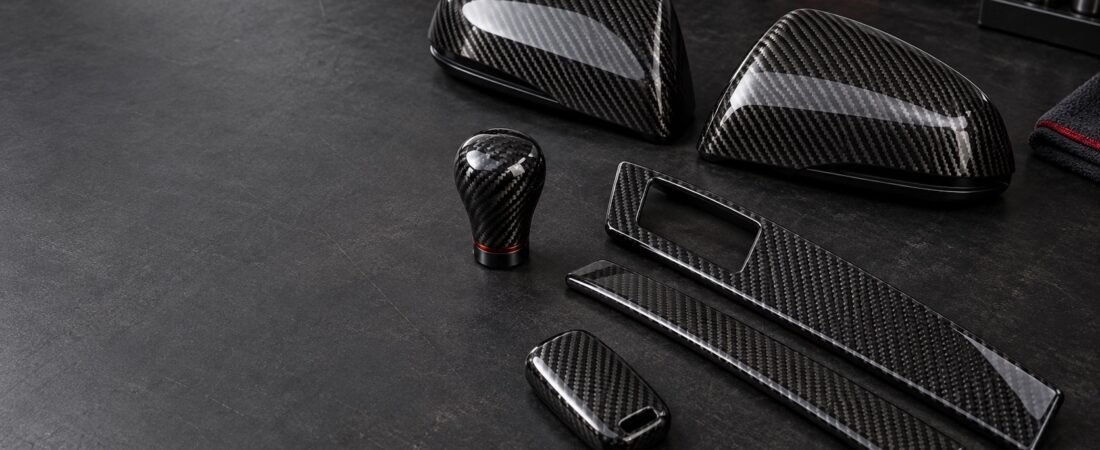
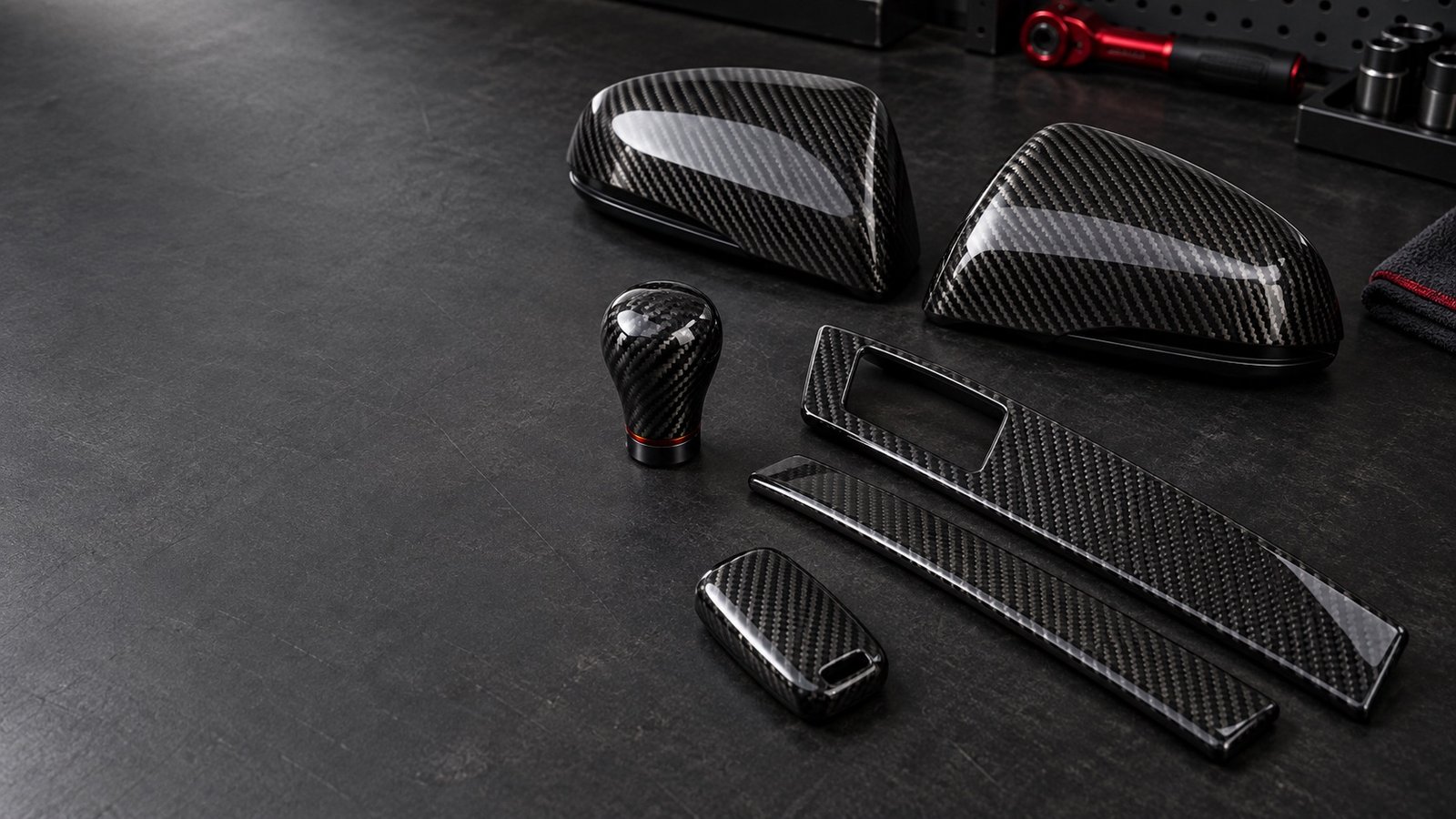
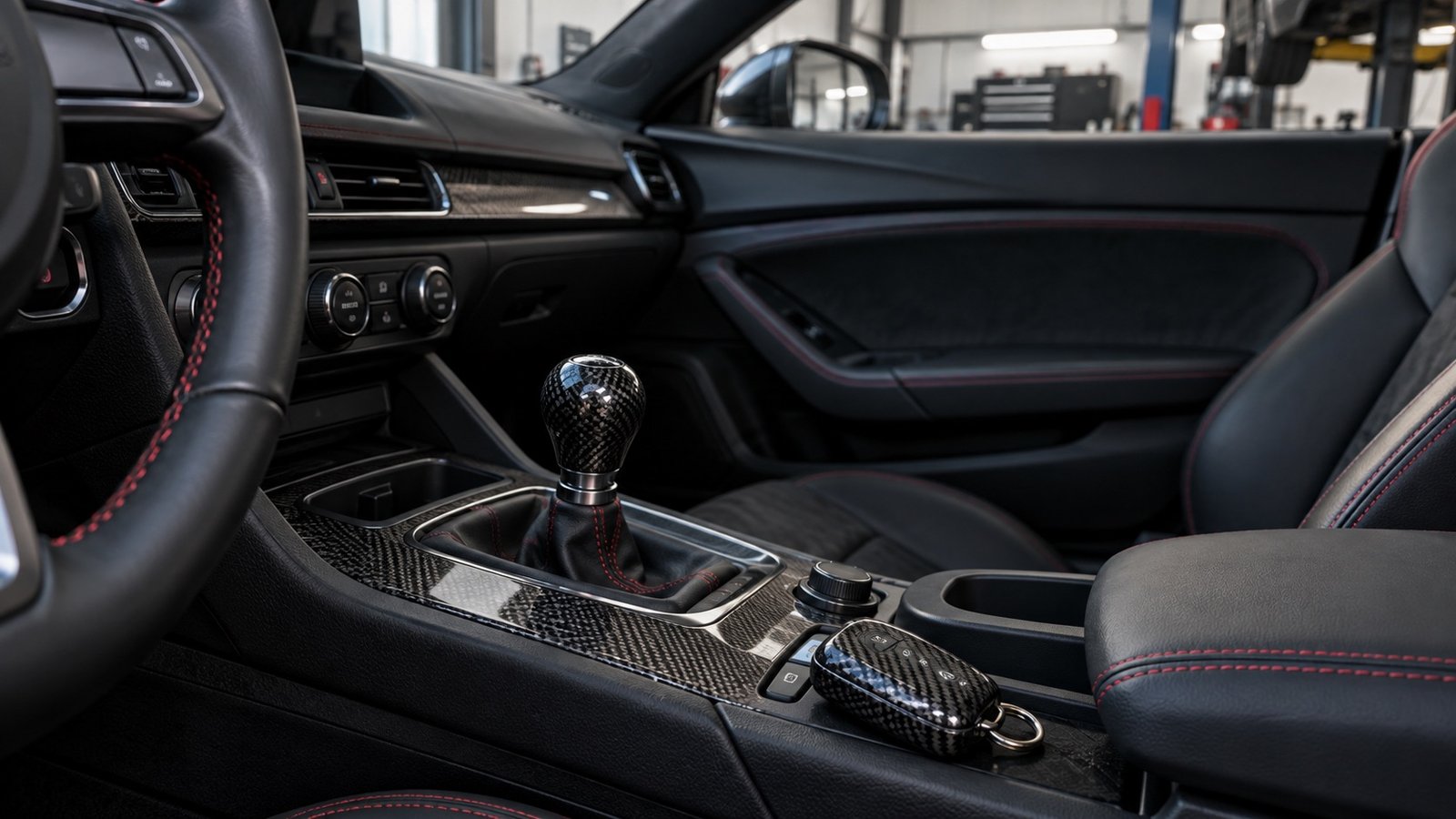
A small carbon-fiber upgrade can change the character of a car without turning it into a full build. Mirror caps add a sharper exterior detail. A shift knob changes something you touch on every drive. Console trim can make an ordinary cabin feel more deliberate.
The problem is that carbon fiber car accessories can describe very different products. One may be a full carbon-fiber composite part. Another may use a genuine carbon skin over a molded base. A third may simply print a weave pattern onto plastic. All three can look similar in a thumbnail, but they differ in construction, finish, fit, price, and long-term appearance.
Use these seven checks to understand what you are buying—and to avoid paying a real-carbon price for a carbon-look part.
First, know the three common constructions
| Construction | What it is | Best use | What to expect |
|---|---|---|---|
| Full carbon-fiber composite | Carbon reinforcement and resin form the part itself | Lightweight replacement shells and premium custom parts | Highest material authenticity; quality depends on layup, molding, and finishing |
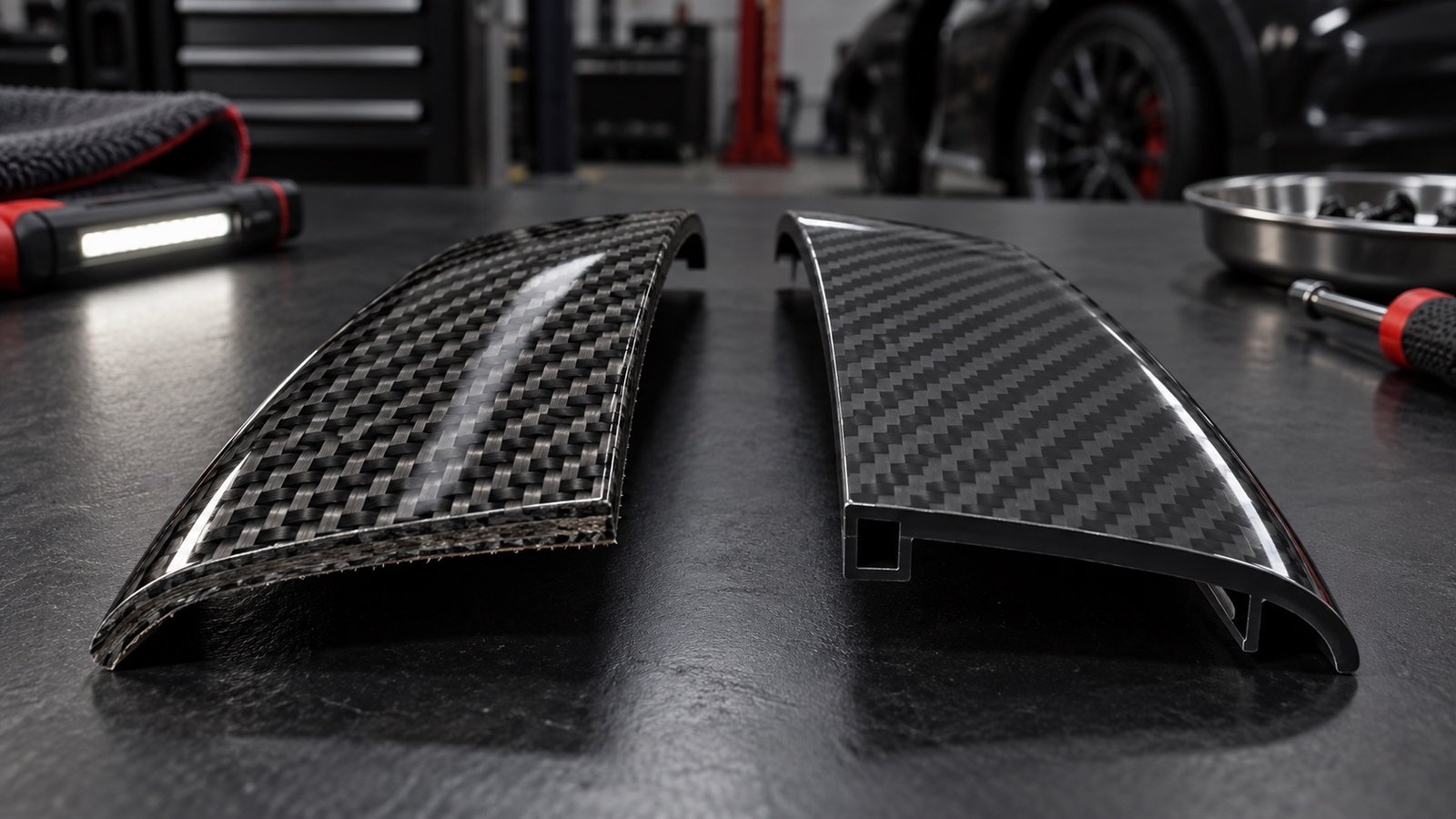
| Carbon skin over a substrate | Genuine carbon fabric is laminated over ABS, fiberglass, or another base | Complex trim shapes and accessories that need stable mounting geometry | Real weave appearance with a practical molded structure |
| Carbon-look plastic or film | A printed, hydro-dipped, or wrapped pattern imitates carbon | Budget styling changes | Visual effect only; no carbon reinforcement |
None of these categories is automatically right for every application. A key cover does not need motorsport-grade structural performance. A replacement mirror shell needs accurate mounting geometry more than a dramatic weight claim. The important thing is honest construction and the right part for the job.
1. Read the construction—not just the word “carbon”
Look for a direct description such as “full carbon composite,” “genuine carbon overlay on ABS,” or “carbon-look ABS.” Be cautious when a listing repeats “carbon style” or “carbon pattern” but never states what the part is made from.
For real carbon fiber car accessories, a trustworthy description should separate the visible carbon layer, the substrate, and the finish. If the seller cannot explain those three elements, the product photo is doing too much of the selling.
2. Inspect the weave from more than one angle
Real woven fabric has depth. As light moves across a finished part, the bundles beneath the clear coat create subtle changes in contrast. A printed pattern usually looks flatter and more mechanically repetitive.
Do not demand impossible visual perfection, though. Complex curves can make the weave open, compress, or change direction. That may be normal draping rather than a defect. What matters is whether the pattern follows the shape intentionally and remains balanced across a matched pair.
Ask for:
- A straight-on photo and a raking-light photo
- Close-ups of corners and tight curves
- Both pieces when buying a left/right pair
- The rear surface or an exposed edge
3. Check the back, edges, and cutouts
The glossy face is the easiest area to photograph. The reverse side reveals how the part was actually built.
On a replacement component, inspect mounting tabs, clip locations, openings, and edge thickness. On an overlay, check whether the inner surface follows the original part closely and leaves room for consistent adhesive contact. Rough edges, flooded mounting holes, or resin-heavy corners can turn a beautiful part into an installation problem.
This is also where you can often distinguish a full composite shell from a carbon-skinned plastic part. Ask for an underside photo before ordering if the construction matters to you.
4. Treat the clear coat as part of the product
Carbon fabric provides the visual pattern, but the resin and topcoat create the surface you see and maintain. Look for an even finish without obvious pinholes, dry-looking patches, cloudy areas, deep sanding marks, or heavy waves around edges.
Exterior accessories should have a finish intended for outdoor exposure. No finish is maintenance-free: wash with a mild automotive cleaner, avoid abrasive compounds unless the finish can be corrected, and address chips before moisture and contamination reach the underlying layers.
5. Verify exact vehicle fitment
“Universal” is often a warning sign for parts that follow a vehicle-specific contour. Confirm:
- Model year or generation
- Body style and trim
- Left-hand-drive or right-hand-drive differences, when relevant
- Sensors, cameras, buttons, lighting, or access openings
- Whether the listing is an overlay or a full replacement
Two vehicles with the same model badge can use different mirror housings, console layouts, or switch cutouts. RevexaAuto recommends treating year, make, model, trim, and clear photos as the minimum fitment package—not an optional extra.
6. Understand how the part mounts
Small accessories usually use clips, fasteners, adhesive, or a combination. Each method has a different risk.
An adhesive overlay depends on clean preparation, full contact, and correct alignment. A replacement shell depends on precise tabs and clip locations. A shift knob depends on thread pitch, adapters, reverse-lockout clearance, and secure tightening. Before buying, make sure the product includes the required hardware and realistic installation instructions.
If removal involves airbags, wiring, cameras, or fragile painted parts, professional installation is the sensible choice.
7. Match expectations to the accessory
Small carbon fiber car interior accessories are usually chosen for finish, touch, and visual consistency—not meaningful vehicle weight reduction. An overlay may even add a small amount of weight. That does not make it a bad product; it simply means styling and fit should be the honest reasons to buy it.
Choose the upgrade based on what you will notice:
- Mirror caps: exterior contrast, weave symmetry, and panel fit
- Shift knobs: grip shape, thread compatibility, temperature feel, and shift action
- Console trim: edge alignment, switch clearance, and glare control
- Key covers: button access, signal clearance, and pocket comfort
A five-minute pre-purchase checklist
Before clicking buy, answer these questions:
- Does the listing name the actual construction?
- Can I see the weave, edges, and rear surface?
- Is the finish suitable for the part’s location?
- Does the part match my exact vehicle and trim?
- Is it a cover or a replacement?
- What mounting hardware or adhesive is included?
- Can the seller review my fitment information before shipping?
If two or more answers are unclear, pause and ask. The best carbon-fiber accessory is not the one with the glossiest thumbnail. It is the one that arrives with the construction, contour, finish, and mounting method you expected.
Frequently asked questions
Are real carbon fiber car accessories always lighter?
No. A full replacement composite part may be lighter than the original, but a carbon overlay or skin uses a substrate and may not reduce weight. For small accessories, fit, finish, and feel are usually more important than grams.
Is forged carbon better than woven carbon?
Not automatically. They use different reinforcement forms and create different visual patterns. The finished part’s design, fiber placement, resin system, molding, and quality control matter more than the pattern name alone.
Can carbon-look ABS still be a good choice?
Yes—when it is described honestly and the goal is affordable styling. It should simply not be marketed or priced as genuine carbon-fiber composite.
How do I keep glossy carbon-fiber accessories looking good?
Use gentle automotive wash products and soft towels. Avoid harsh solvents and aggressive abrasion. Inspect exterior pieces periodically for chips, lifting edges, or finish damage.
Make fitment the first step
Send RevexaAuto your vehicle year, make, model, trim, and clear photos of the original part. We can help you organize the fitment details and the questions worth confirming before you choose a carbon-fiber accessory.
CTA: Request a RevexaAuto fitment review.
Related guides: Carbon Fiber Mirror Caps: Covers vs Replacements Explained · Carbon Fiber Shift Knob Guide: Get the Right Fit the First Time