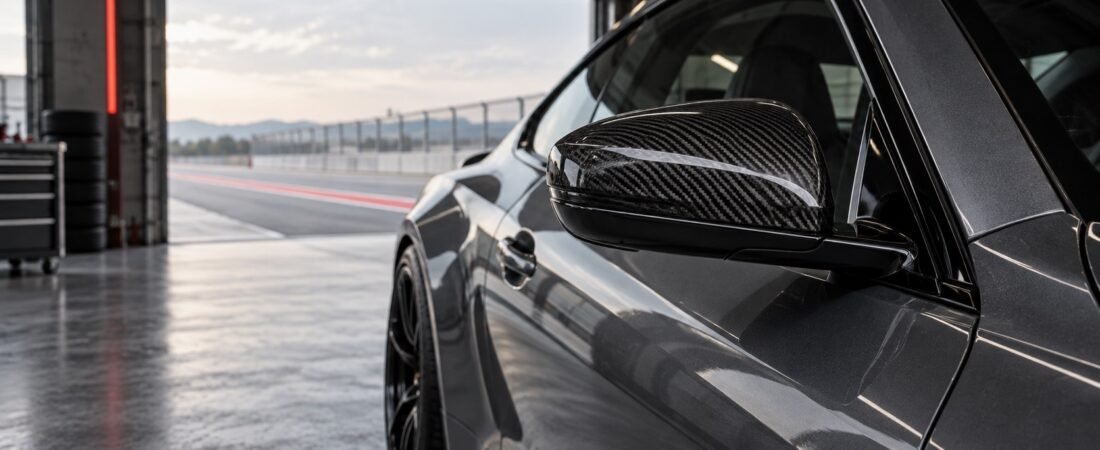
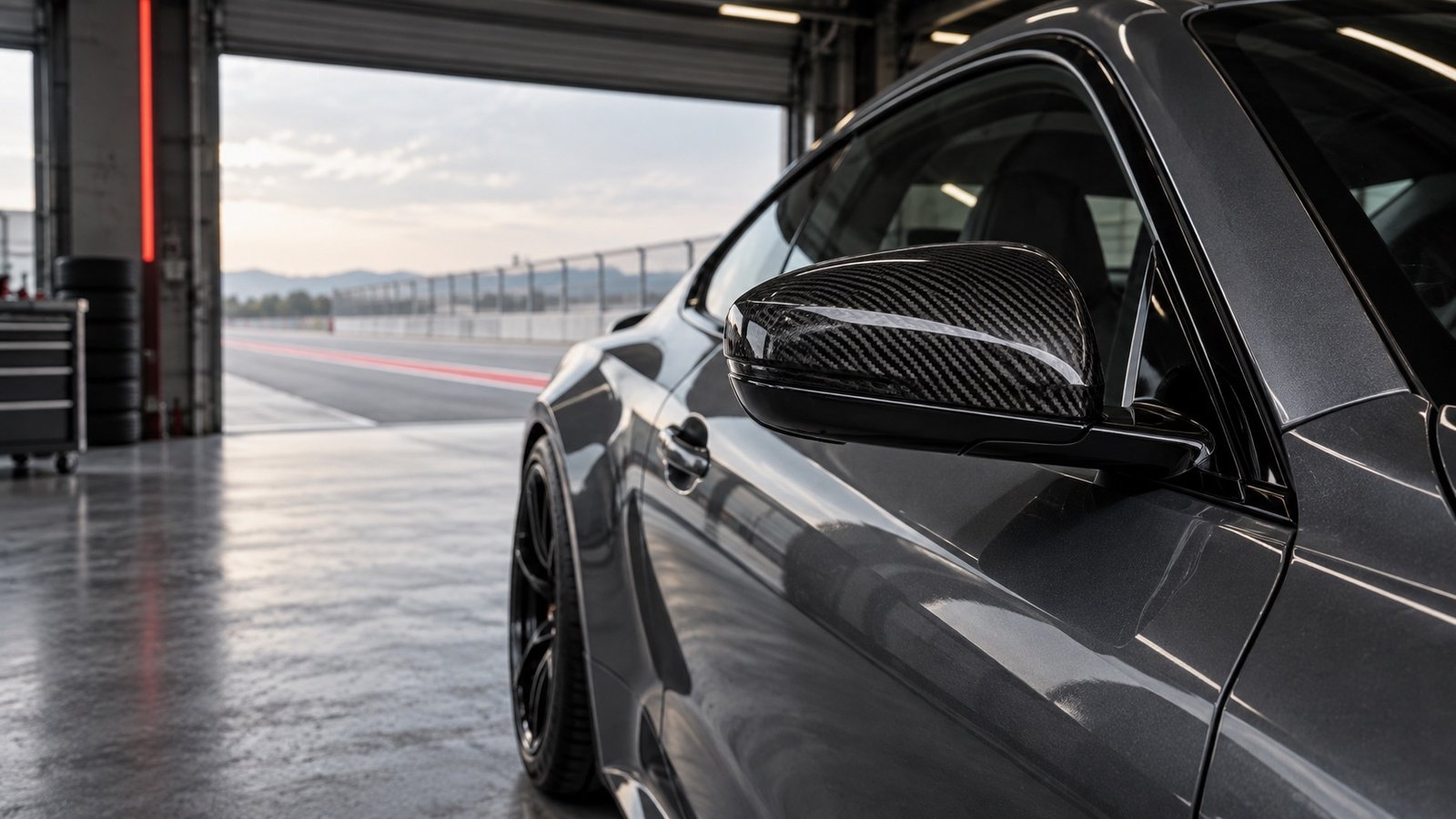
Few upgrades create as much visible contrast from such a small part as carbon fiber mirror caps. They sit at eye level, catch light from every angle, and can connect an exterior theme without changing the car’s original body lines.
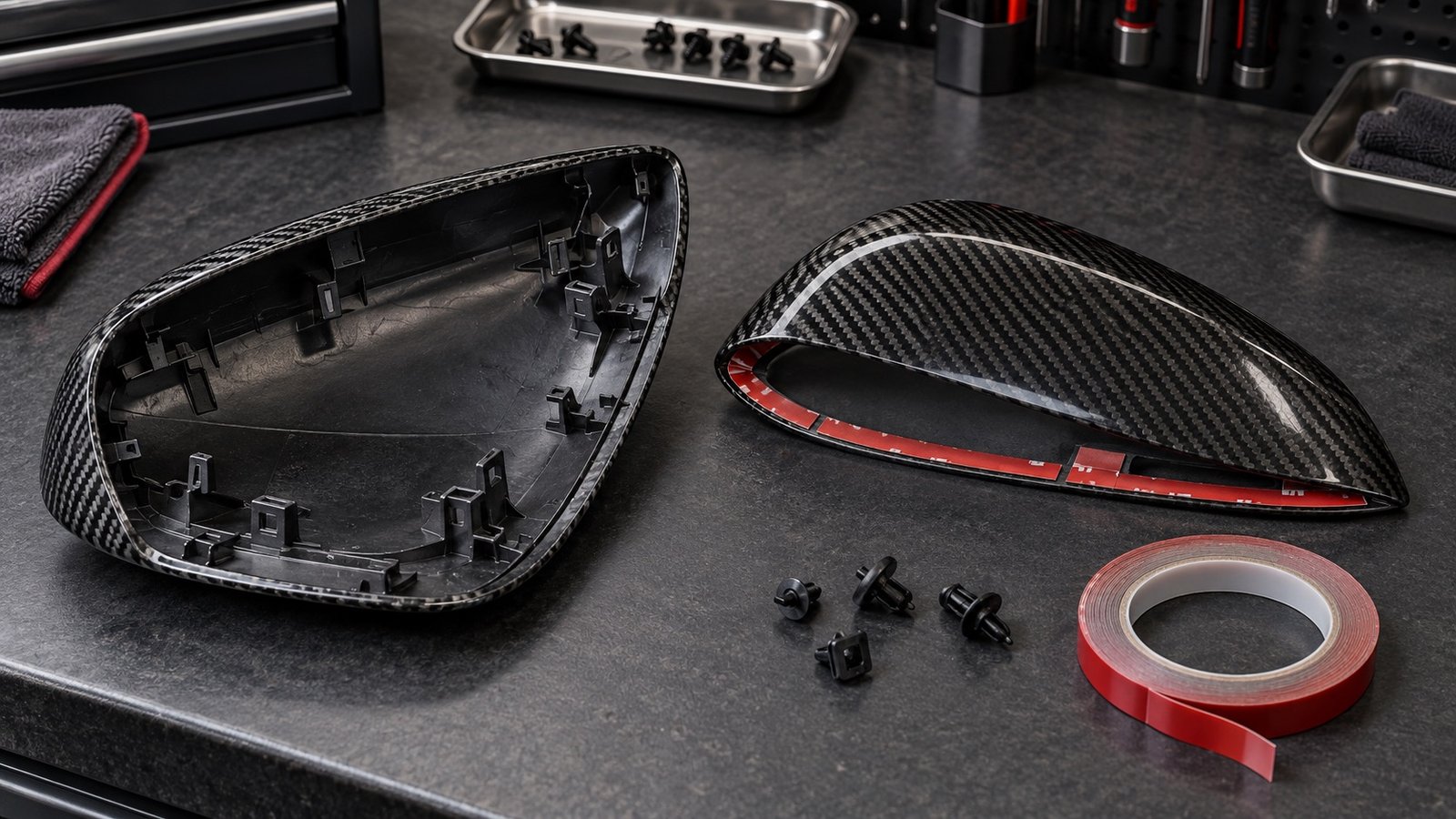
But “mirror caps” can mean two different products: a cover that bonds over the original shell or a replacement shell that takes its place. Choosing the wrong type can lead to bulky edges, loose clips, blocked lighting, or a part that simply does not match your housing.
Here is how the two designs differ—and what to check before ordering.
Mirror-cap covers vs replacement shells
| Detail | Overlay cover | Replacement shell |
|---|---|---|
| What it does | Fits over the original painted cap | Replaces the original cap |
| Typical mounting | Automotive adhesive tape, sometimes with edge retention | Factory-style clips, tabs, and/or fasteners |
| Installation | Usually quicker and reversible with care | More disassembly and a greater risk of damaging clips |
| Final profile | Adds a small amount of thickness | Can retain a more factory-like profile |
| Main fitment risk | Edge coverage and adhesive contact | Tab position, clip geometry, and internal clearance |
| Best for | A straightforward visual change | A cleaner replacement-style result |
An overlay is not automatically “cheap,” and a replacement is not automatically “better.” A well-shaped cover can look excellent. A poorly molded replacement can fit worse than the original part. Judge each design by its construction and accuracy.
1. Confirm the exact housing—not just the model name
SEMrush shows strong search demand for model-specific phrases such as BMW carbon fiber mirror caps, Honda Civic mirror caps, Audi S5 mirror caps, and other generation-level terms. That search behavior reflects a real fitment issue: mirror housings can change by year, market, body style, trim, or equipment package.
Before you buy, confirm:
- Vehicle year, make, and model
- Generation or chassis code, if known
- Sedan, coupe, hatchback, wagon, SUV, or other body style
- Trim or appearance package
- Left-hand-drive or right-hand-drive market, when relevant
- Turn-signal, camera, puddle-light, or sensor openings
- Photos of the original cap from the front, side, underside, and door-side edge
Do not assume an “M-style” shape fits every BMW housing or that two cars sharing a platform use identical caps. Style names describe appearance; they do not prove compatibility.
2. Ask whether the part is full carbon, carbon-skinned, or carbon-look
Real carbon fiber mirror caps may be full composite shells or molded bases laminated with genuine carbon fabric. Both can display real weave. Carbon-look ABS uses a printed or transferred pattern.
The listing should say which one it is. If weight is your priority, ask for the part weight and the original part weight instead of assuming. For most street cars, the visual finish and accurate fit will matter more than a small weight difference at the mirror.
3. Check left-to-right weave symmetry
A matched pair should look intentional on the car. Ask for one photo showing both caps together. Compare:
- Weave direction
- Pattern angle at the outer edge
- Distortion around the tightest curve
- Clear-coat depth and gloss level
- Color consistency under the same light
Perfect fabric alignment over a compound curve is difficult, but the pair should not look like two unrelated parts. If your car already has a carbon hood, spoiler, or interior trim, decide whether you want a similar 2×2 twill direction or a contrasting forged-carbon pattern.
4. Inspect the perimeter and mounting surface
For an overlay, the inner contour must sit close enough to the original shell for adhesive to make full contact. Large hollow areas or warped edges create lifting risk. Ask whether the adhesive is pre-applied and whether adhesion promoter is recommended for your surface.
For a replacement, inspect every tab and clip in underside photos. The locations should mirror the original part. Thick clear coat around clips, weak-looking tabs, or unfinished edges may cause trouble during installation.
5. Look for a finish made for exterior use
Mirror caps face sun, rain, road film, insects, wash chemicals, and repeated temperature changes. Look for an even exterior clear coat and ask how the finish should be maintained. A seller should not promise that any glossy surface will remain perfect without care.
After installation:
- Hand-wash the edges gently during the first curing period recommended by the adhesive supplier
- Avoid aiming high-pressure water directly at overlay edges
- Use non-abrasive wash products and clean microfiber towels
- Inspect for chips, lifting, or loose movement
6. Decide whether you should install them yourself
An overlay is often suitable for a careful DIY installation if the fit has been dry-tested first. A replacement shell may require folding the mirror, removing glass, releasing clips, disconnecting heating wires, or working around a signal module. The exact process depends on the vehicle.
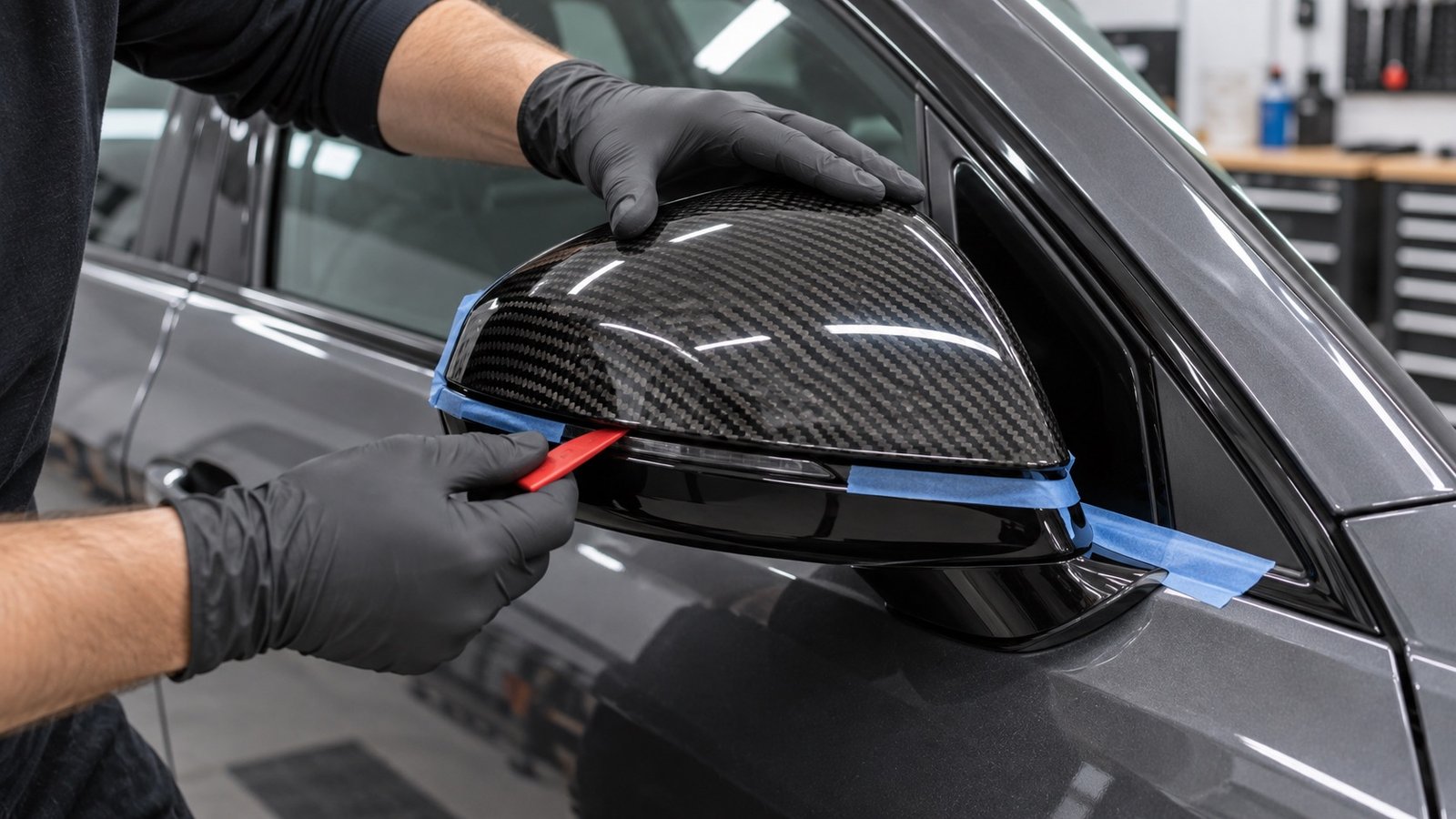
For a typical adhesive cover:
- Wash and fully dry the original cap.
- Remove wax, silicone, and oily residue with a surface-safe cleaner.
- Dry-fit the cover without removing the adhesive liner.
- Mark a repeatable alignment point with low-tack tape.
- Apply the cover gradually, keeping the perimeter gap even.
- Hold pressure according to the adhesive instructions.
- Keep the part dry and undisturbed for the stated cure time.
Stop if the cover needs heavy force to sit flat. Adhesive should secure a correctly shaped part, not pull a warped part into shape.
The RevexaAuto mirror-cap buying checklist
Before RevexaAuto considers a mirror-cap fitment ready to review, the essential information is simple:
- Exact vehicle and market
- Clear original-housing photos
- Cover or replacement preference
- Material construction
- Weave or forged-carbon style
- Gloss or matte finish
- Included mounting method
- Sensor, camera, lighting, and cutout requirements
This checklist takes minutes and prevents the most common mismatch: ordering by model name alone.
Frequently asked questions
Are carbon fiber mirror caps worth it?
They can be if you want a visible, reversible styling change and choose a set with honest construction and verified fitment. They are a poor value when the weave is inconsistent, the edges lift, or the housing match is only approximate.
Do mirror-cap covers fall off?
A properly shaped cover installed on a correctly prepared surface with suitable automotive adhesive should remain secure. Fit, surface preparation, adhesive coverage, pressure, cure time, and environment all matter. Never rely on adhesive to correct a warped part.
Do carbon fiber mirror covers affect signals or cameras?
They can if the product blocks an opening, changes a camera’s field, or interferes with a module. Choose a version designed for your exact equipment and test all functions after installation.
Can I remove an overlay later?
Often yes, but removal can damage paint or leave adhesive residue if rushed or overheated. Use a vehicle-appropriate process or ask a professional detailer or installer.
Is matte or gloss carbon better for mirror caps?
Neither is universally better. Gloss emphasizes weave depth and often matches glossy exterior carbon. Matte reduces reflections and creates a more understated finish. Match the rest of the car and confirm how each finish should be maintained.
Check fitment before choosing the finish
The best-looking cap is useless if it was molded for a different housing. Send RevexaAuto your vehicle details and original-mirror photos before you commit to a set. A fitment-first review gives you a better foundation than any product title alone.
CTA: Request a RevexaAuto mirror-cap fitment review.
Related guide: Real Carbon Fiber Car Accessories: 7 Checks Before You Buy