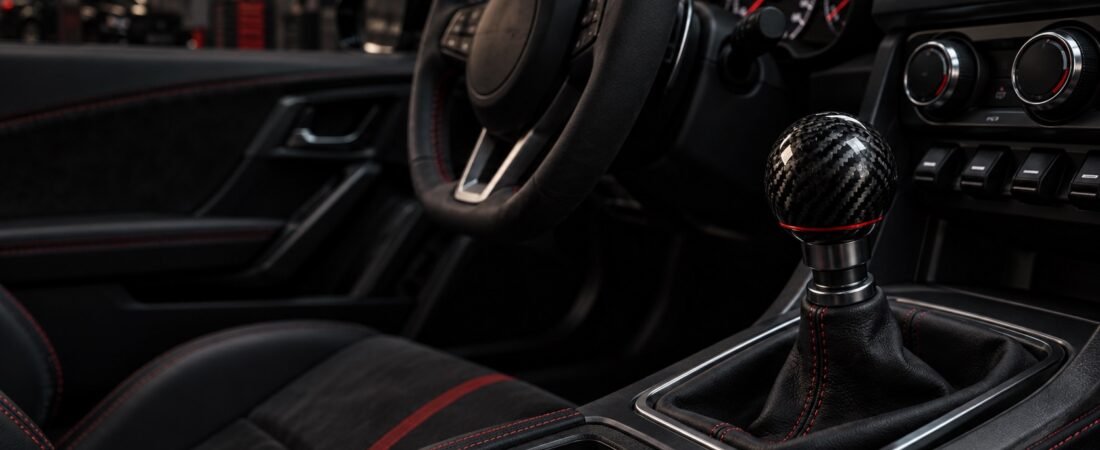
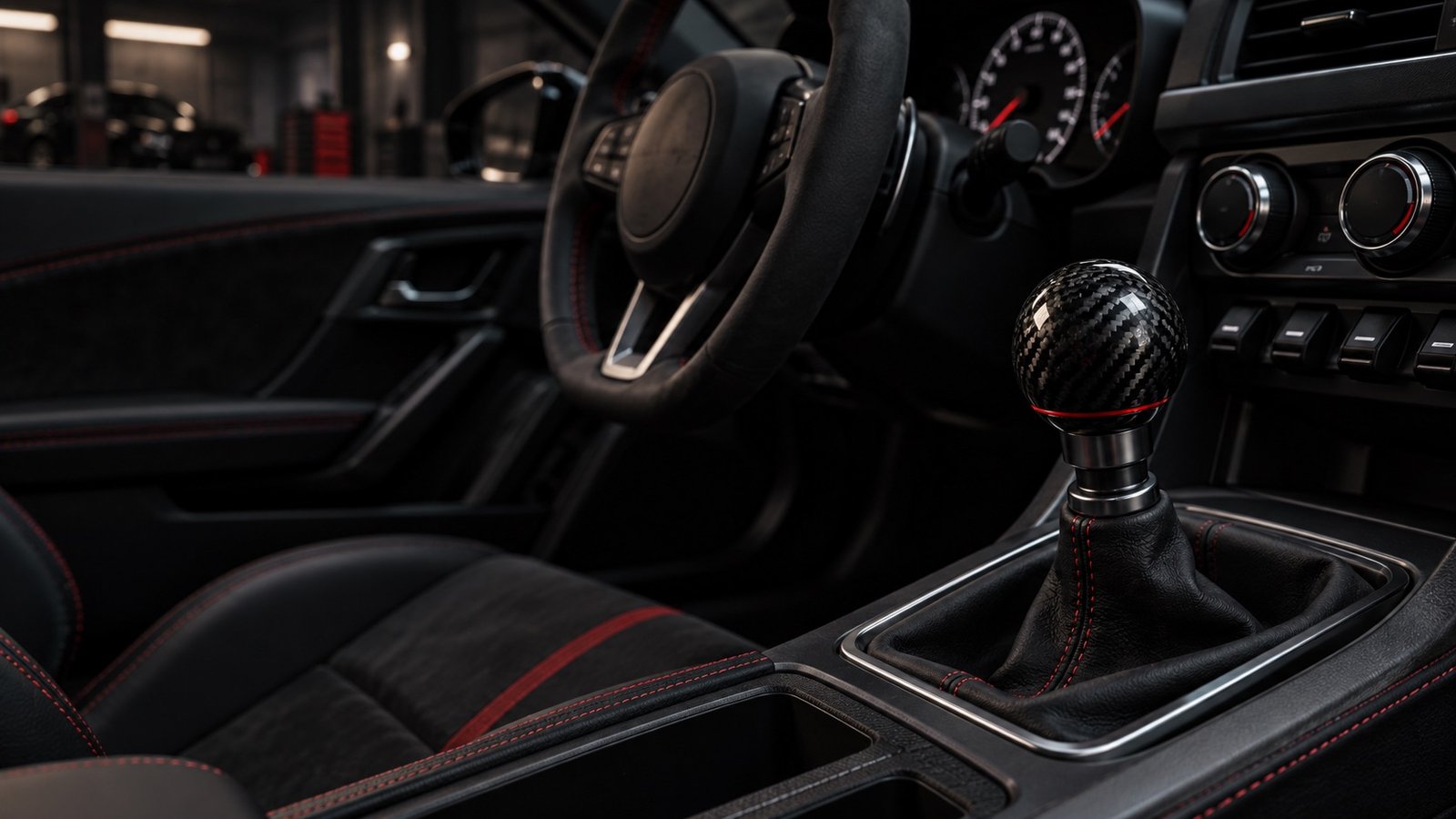
A carbon fiber shift knob is small, visible, and used on every drive. That makes it one of the most satisfying interior changes—and one of the easiest to buy incorrectly.
The product photo may look right while the thread pitch is wrong. A universal adapter may fit the lever but leave the knob loose. A tall base may block a reverse-lockout collar. A beautiful metal-heavy design may change the shift feel more than you expected.
This guide covers the details that matter before you choose woven carbon, forged carbon, or a black-and-red style.
1. Identify your shifter type before measuring anything
Start with the mechanism, not the knob.
- Threaded manual lever: the original knob screws onto a defined thread.
- Unthreaded manual lever: the knob may clamp with set screws or a vehicle-specific sleeve.
- Reverse-lockout system: a collar, ring, or lift mechanism must move freely beneath the knob.
- Button, trigger, electronic, or automatic selector: the factory knob may contain a release mechanism, wiring, illumination, or gear-selection electronics.
A simple universal manual knob is not a safe substitute for a selector with integrated controls. If the original part has wiring, a button, or a release trigger, use a vehicle-specific solution and follow the correct service procedure.
2. Confirm thread pitch—not just diameter
Thread size has two parts: nominal diameter and pitch. Two threads can look nearly identical and still be incompatible. Common adapter kits include several sleeves, but that does not guarantee compatibility with every vehicle.
The best sources are the vehicle’s service information, a verified fitment chart, or a direct measurement with the right gauge. Avoid forcing a knob that starts crooked or binds after one turn; cross-threading can damage the lever or adapter.
Before ordering, record:
- Vehicle year, make, model, and trim
- Transmission type and number of forward gears
- Lever thread specification, if threaded
- Lever diameter, if unthreaded
- Reverse-lockout style and travel
- Distance available between the knob base and lockout collar
3. Choose the right mounting system
Direct-thread knob
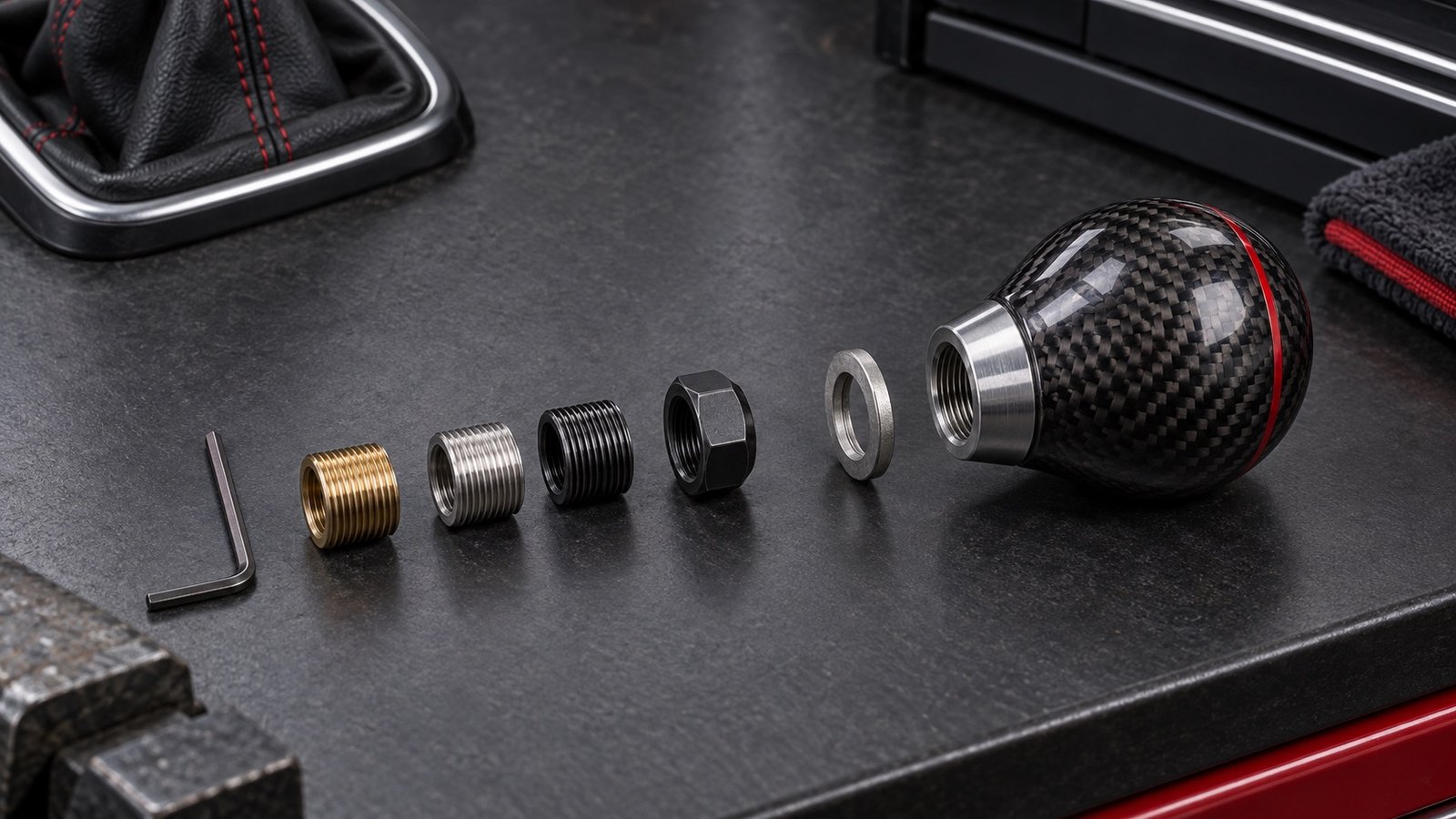
This is the cleanest option when the knob is manufactured for the vehicle’s thread. It usually uses a locking nut or adjustable collar to align any shift-pattern graphic.
Threaded adapter
An internal adapter allows one knob body to fit several thread sizes. Use the exact adapter specified for the lever and make sure it seats fully. A stack of improvised adapters creates extra joints that can loosen.
Set-screw adapter
A sleeve slides over an unthreaded lever and is retained by screws. Even screw tension and a correctly sized sleeve are essential. This design should not interfere with a moving reverse-lockout component.
After installation, the knob should not rotate, rock, rattle, or contact the console through the full shift pattern.
4. Check reverse-lockout clearance
This is the fitment detail most attractive product photos rarely show. If your car uses a lift-up collar, the knob base must leave enough room for the collar to travel fully and return freely. Some cars need a recess inside the knob; others need a dedicated adapter or extension.
Test reverse selection with the vehicle stationary and secured. If the lockout sticks, the knob loosens, or the boot is pulled tight, stop and correct the installation before driving.
5. Decide how you want the shift to feel
Shape and mass affect the experience more than the material label.
- Round: easy to approach from different hand positions; classic appearance
- Teardrop: adds directional grip and a natural palm rest
- Tall cylindrical: changes hand position and can reduce reach, but may add leverage
- Compact low-profile: creates a shorter visual stance but may require more wrist reach
A heavier knob can make the lever carry more momentum through the gate. Some drivers like that smoother sensation; others prefer a lighter, more direct feel. Carbon construction does not automatically mean the complete knob is lightweight because the core, threaded insert, and base may be metal.
Also consider surface temperature. A carbon-covered grip can feel less harsh than a fully exposed metal knob in extreme sun or cold, but exposed metal bands and the cabin environment still affect temperature.
6. Choose woven, forged, or black-and-red carbon
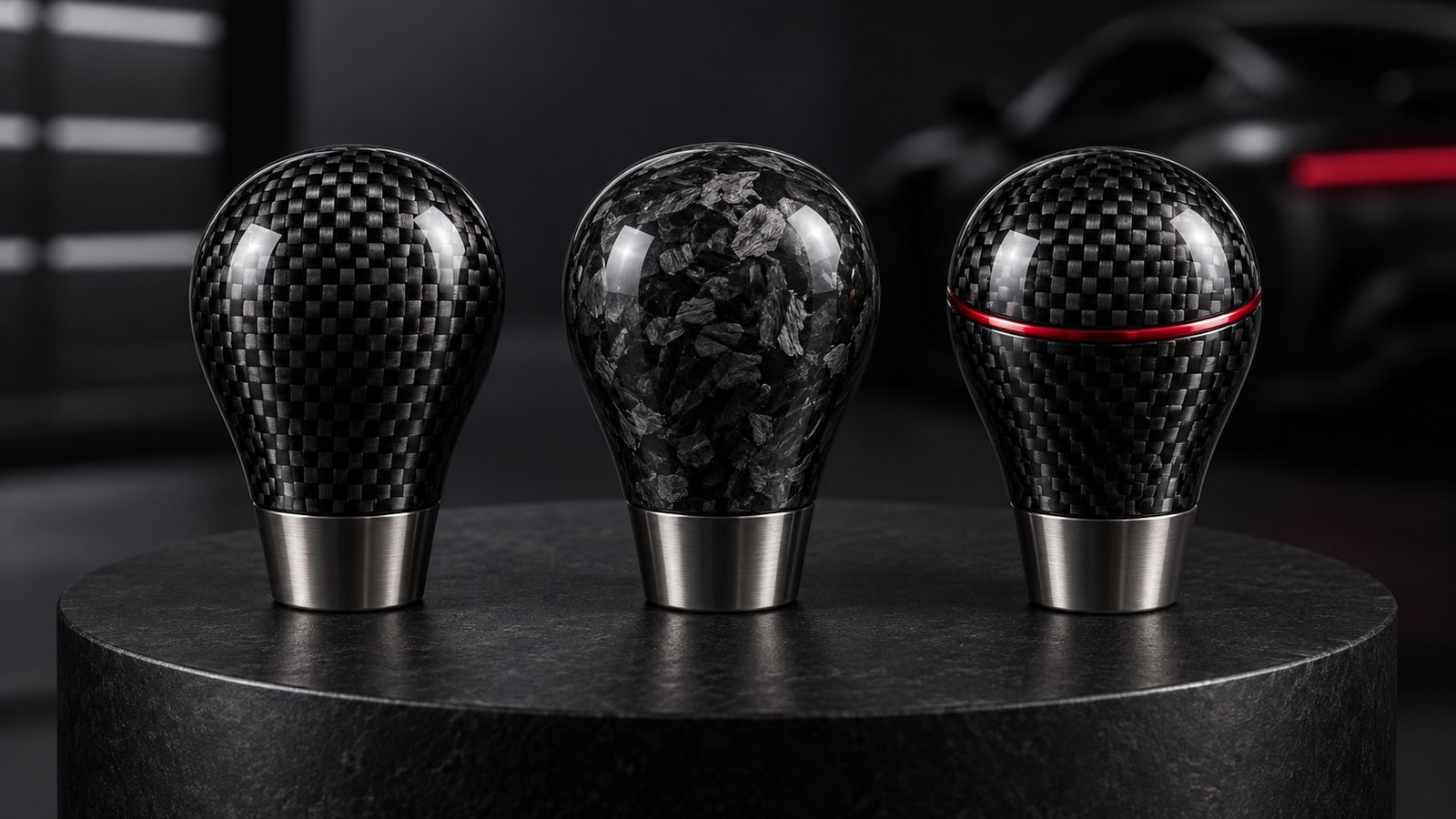
Woven carbon fiber
Traditional 2×2 twill creates the familiar diagonal pattern. It pairs naturally with woven console trim, steering-wheel accents, or mirror caps.
Forged carbon fiber
A forged carbon fiber shift knob has a more irregular, marbled appearance created by chopped reinforcement rather than a continuous woven cloth pattern. Choose it for the visual texture, not because the word “forged” automatically proves that one accessory is stronger or better.
Black and red
SEMrush shows notable search demand for carbon fiber black and red shift knobs. The combination works best when the red element is restrained and repeats an existing cabin detail—stitching, a gauge needle, a seat stripe, or a brake-caliper accent. One controlled line looks intentional; too many competing red parts can make the cabin feel disconnected.
7. Inspect construction and finish
Ask whether the visible surface is full composite, genuine carbon laminated over a core, or carbon-look material. On a shift knob, a durable core and secure threaded insert are important because the part is handled and loaded repeatedly.
Check for:
- A centered, secure insert
- Smooth transition between carbon and metal
- No sharp clear-coat edges near the grip
- Even resin and finish without obvious pinholes
- Hardware that matches the advertised mounting system
- Enough base clearance for the boot and lockout
A careful installation sequence
Exact procedures vary by vehicle, but the general logic is consistent:
- Park securely, switch off the vehicle, and protect nearby trim.
- Confirm how the original knob is retained before pulling or twisting.
- Remove the original knob without loading fragile console parts.
- Test the new adapter or thread by hand.
- Position the boot and reverse-lockout components correctly.
- Tighten the knob and locking hardware to the product’s instructions.
- Check every gear position while stationary.
- Confirm the knob remains secure after a short, careful test drive.
Never force a selector, guess at wiring, or bypass a safety lockout to make an accessory fit.
Frequently asked questions
Are carbon fiber shift knobs universal?
No. Many are sold with multi-size adapters, but lever threads, shaft diameters, reverse-lockout systems, boot retainers, and electronic functions vary. Verify your exact mechanism first.
Will a carbon fiber shift knob fit a 6-speed transmission?
The number of gears does not determine mounting compatibility. A carbon fiber shift knob for a 6-speed still needs the correct thread or adapter and enough reverse-lockout clearance. If the knob displays a shift pattern, that pattern must also match the vehicle.
Is a heavier shift knob better?
It is a preference, not a universal upgrade. More mass can make shifts feel smoother to some drivers, while a lighter knob can feel more direct. Choose based on the transmission, lever geometry, and the feedback you prefer.
Can I reuse my factory shift boot?
Often, but the boot-retainer diameter and attachment method must match the new knob or adapter. An incorrect retainer can leave a gap or pull the boot too tightly.
How do I stop a shift knob from rotating?
Use the intended locking nut, collar, thread locker specified by the manufacturer, or properly tightened set screws. Do not overtighten a carbon shell or use an improvised fastener that can damage the lever.
Fit first. Style second.
Choose the weave, forged pattern, and accent color after you know the mounting details. Send RevexaAuto your vehicle information plus clear photos of the original knob, lever, boot, and reverse-lockout mechanism. That gives a fitment review something concrete to work from.
CTA: Request a RevexaAuto shift-knob fitment review.
Related guide: Real Carbon Fiber Car Accessories: 7 Checks Before You Buy