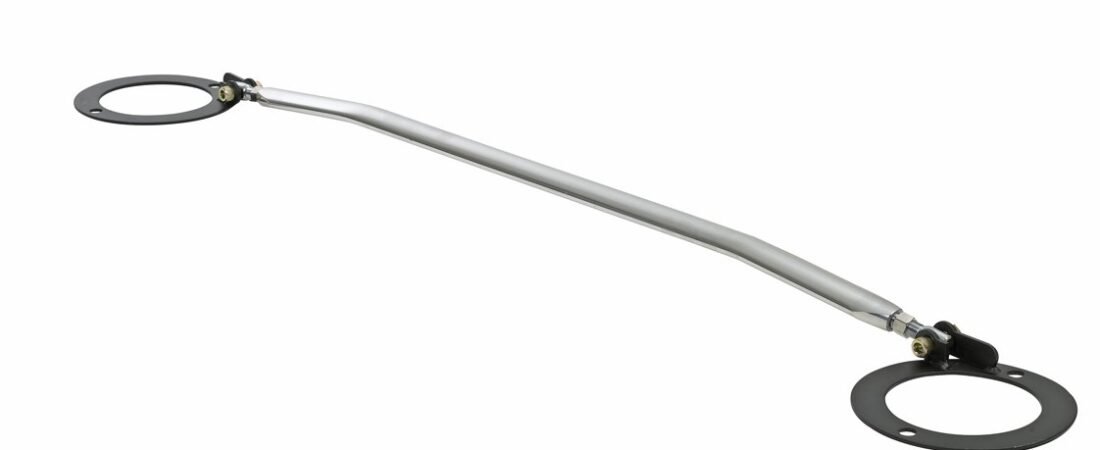
Quick answer: A strut bar, also called a strut tower brace, links the upper suspension mounting areas to add a load path across the body structure. Its purpose is to reduce relative movement between those points under cornering and road loads. It does not change spring rate, replace an anti-roll bar or guarantee a dramatic handling transformation.
The real benefit depends on the vehicle’s original body stiffness, suspension geometry, tire grip, brace design and how the car is driven. A precise, model-specific brace can sharpen consistency or steering feel on the right platform. A flexible bar with weak joints—or one that does not fit cleanly—may add little beyond engine-bay decoration.
Last reviewed: October 1, 2026. Prepared by the RevexaAuto Technical Team. Always follow vehicle-specific service information and the brace manufacturer’s instructions.
What does a strut bar do?
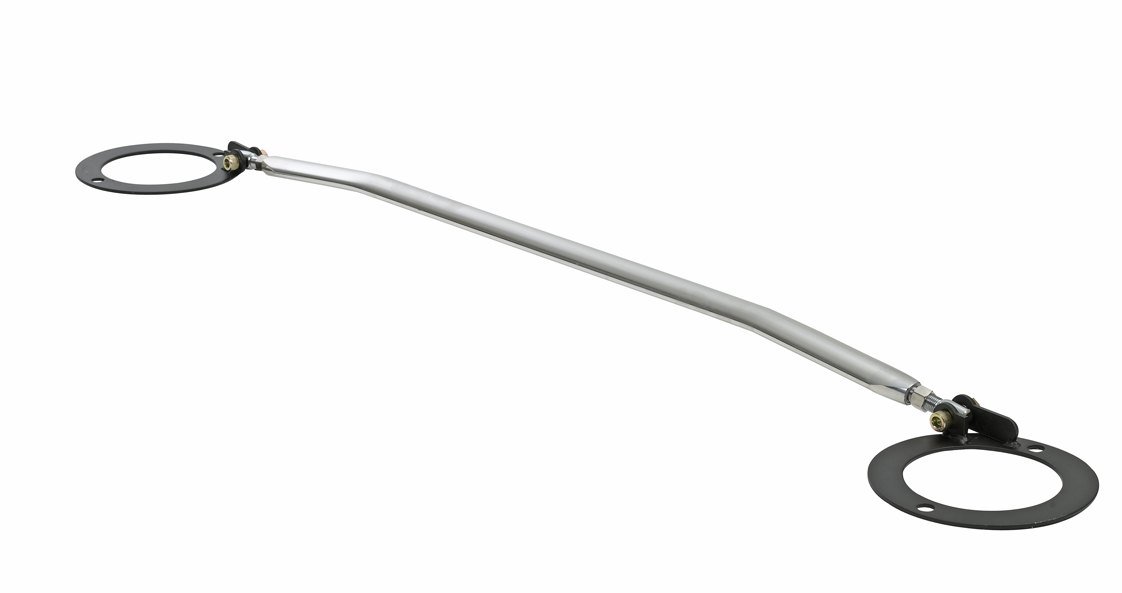
In a MacPherson-strut layout, the upper strut mounts carry suspension loads into the body. Those loads do not remain isolated at one bolt: they travel through the towers, cowl, firewall, floor and other structural paths. The body is already designed to manage them, but no structure is infinitely rigid. A brace attempts to reduce the change in distance and orientation between its mounting regions.
That principle is consistent with engineering literature showing that chassis stiffness can influence vehicle response. An SAE paper on the effect of chassis stiffness on race-car handling balance explains why structural flexibility belongs in the handling model. Research into body-in-white torsional stiffness also shows that stiffness is distributed across a structure, not located in one accessory.
Therefore, a tower brace should be understood as one local reinforcement. It cannot make an open engine bay behave like a complete safety cage, and a result measured on one chassis cannot be promised on another.
What might a driver notice?
- More consistent steering response during quick left-right transitions.
- A clearer sense of the front tires loading on rough or high-grip corners.
- Fewer creaks or small relative movements on some older or less rigid bodies.
- No obvious change in relaxed road driving on a stiff modern platform.
These are plausible outcomes, not guarantees. Tires, alignment, worn bushings, dampers and driver inputs often produce larger changes. Fix mechanical faults before using a brace to chase vague steering symptoms.
Strut brace vs sway bar vs chassis brace
| Part | What it connects | Primary job | What it does not do |
|---|---|---|---|
| Strut tower brace | Upper suspension mounting regions | Reduce relative body movement across that area | Directly increase spring rate |
| Anti-roll or sway bar | Left and right suspension through lever arms and links | Add roll stiffness and alter lateral load-transfer distribution | Brace the body opening like a rigid crossmember |
| Lower chassis brace | Subframe, control-arm or underbody pickup regions | Reinforce a lower structural load path | Automatically correct alignment or worn joints |
| Roll cage | Multiple points through a welded or bolted occupant-cell structure | Motorsport safety and major structural reinforcement when properly engineered | Serve as a casual street accessory |
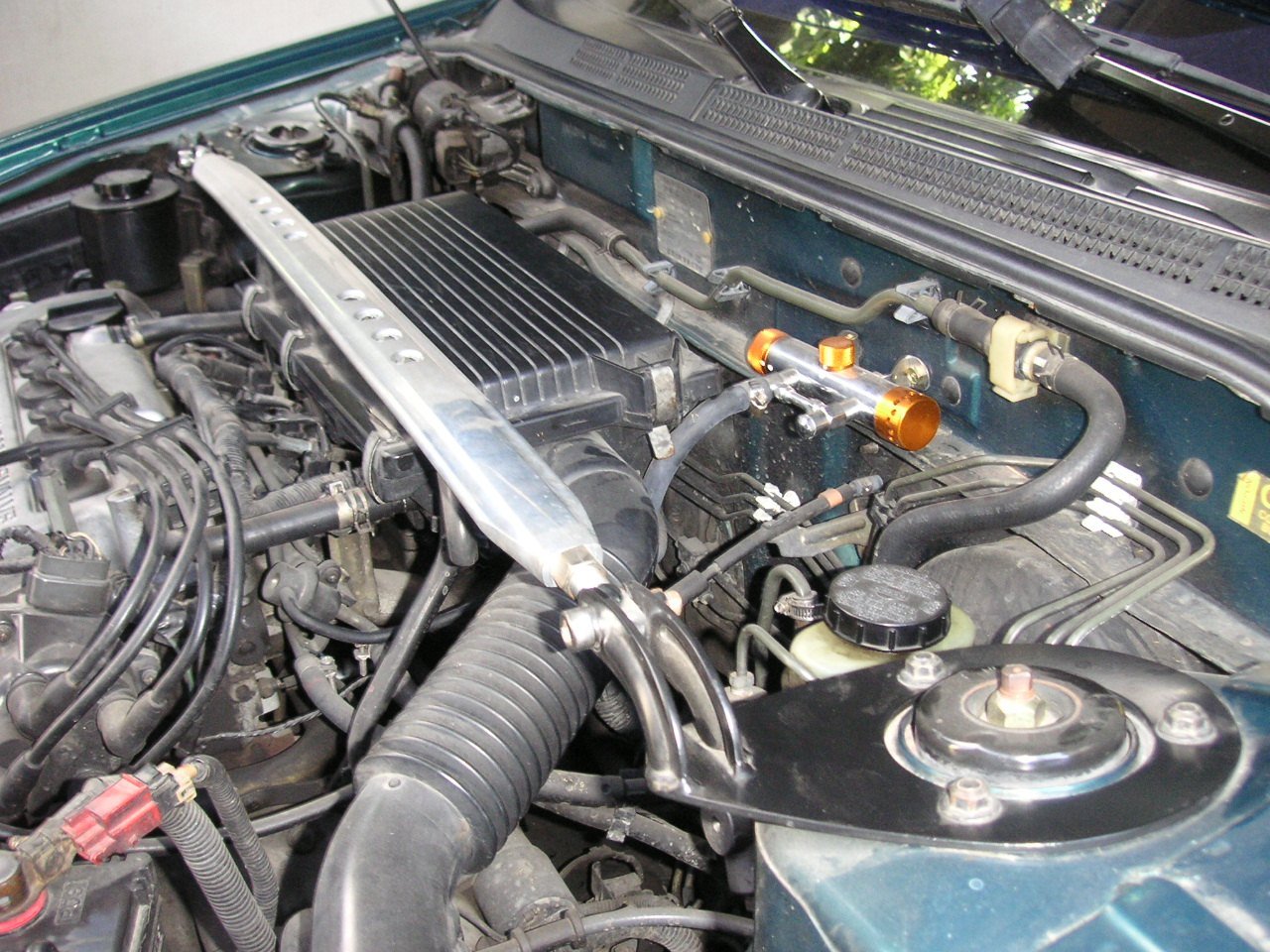
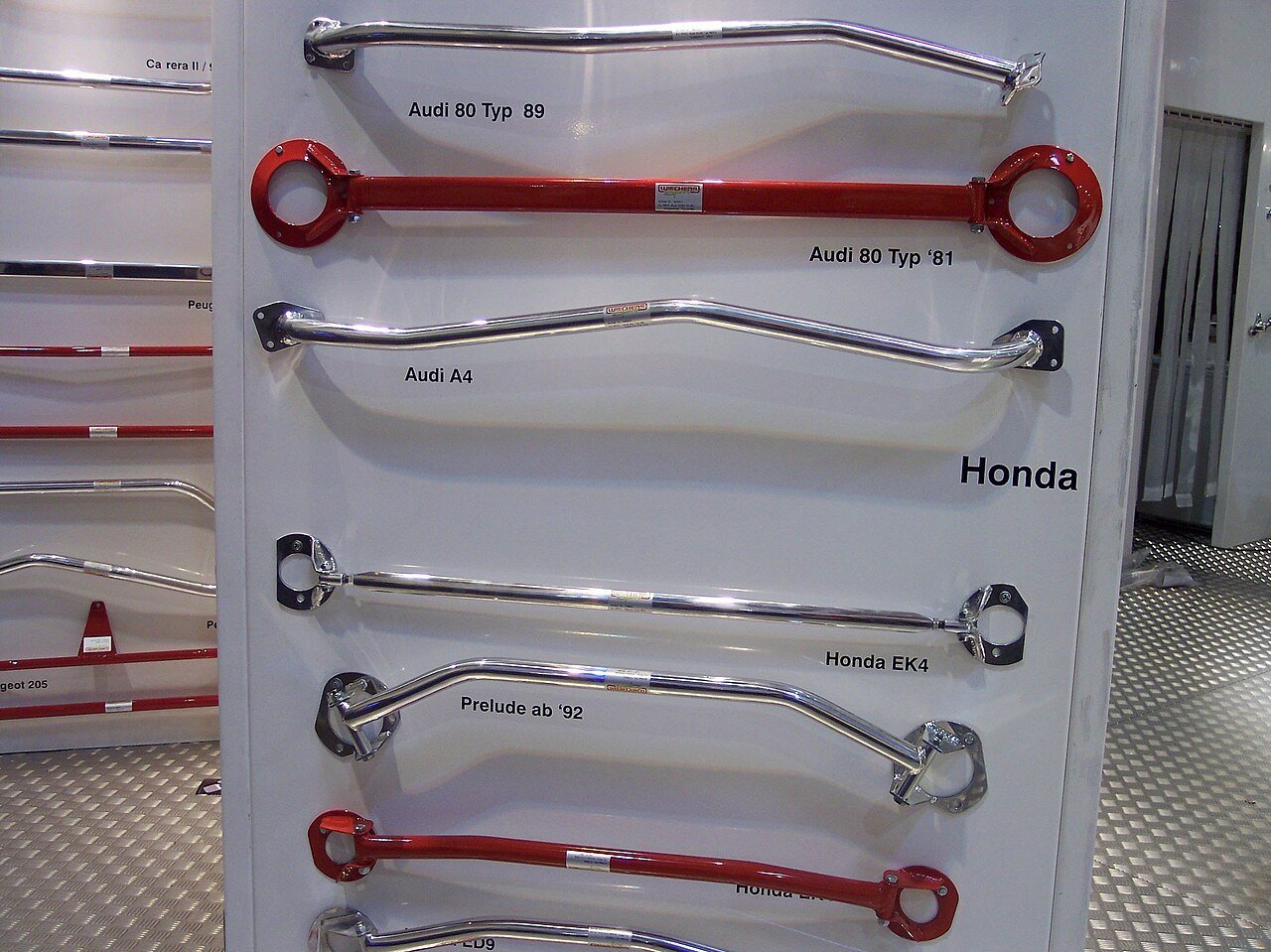
The names are sometimes blurred in product listings, so look at what the part physically joins. A three-point design that also connects to the firewall or cowl is different from a two-point tower-to-tower bar. More points are not automatically better: the added node must be structurally suitable and the geometry must carry load effectively.
When is a tower brace most useful?
A brace has a stronger case when a vehicle has a large engine-bay opening, aging seams, higher-grip tires, firmer suspension or repeated track/autocross loads. Convertibles and older platforms may start with different structural behavior than a modern fixed-roof performance car. On the other hand, some newer bodies already use extensive adhesives, closed sections and factory bracing.
A recent numerical study of body-in-white stiffness optimization illustrates the complexity: mass, modal behavior and the contribution of many panels are considered together. An aftermarket bar changes only part of that system. This is why “you will corner faster” is weaker evidence than a model-specific stiffness test, instrumented lap comparison or repeatable driver evaluation.
What makes a good brace?
A direct, stiff load path
The tube or beam should connect the intended mounting regions with minimal unnecessary bends. Large bends, thin decorative sections or long offset brackets can flex. Jointed designs can aid installation, but every bolted pivot and slotted interface deserves scrutiny. A one-piece part is not automatically superior if it fits poorly or loads the tower unevenly.
Mounting plates that fit the tower
The plate must sit flat on the specified surface without trapping a hose, harness, sealant bead or debris. Hole positions should not require levering the studs into place. A mismatch can create preload, damage threads or prevent the original nuts from achieving proper engagement.
Material chosen as a system
Steel is stiff, economical and easy to fabricate, but it needs corrosion protection and can be heavier. Aluminum can save mass and resist corrosion, although the design may require a larger section. Carbon-fiber composite can combine low mass with tailored stiffness, but laminate design, inserts and bond quality matter. Do not compare materials by name alone; compare complete-part mass, geometry, joint design and test evidence.
RevexaAuto’s carbon-fiber brace for BMW S58 G8X applications and dry-carbon engine X-brace for the second-generation Audi R8 illustrate why the application and mounting layout must be read before the finish or material catches your eye.
Seven fitment checks before buying
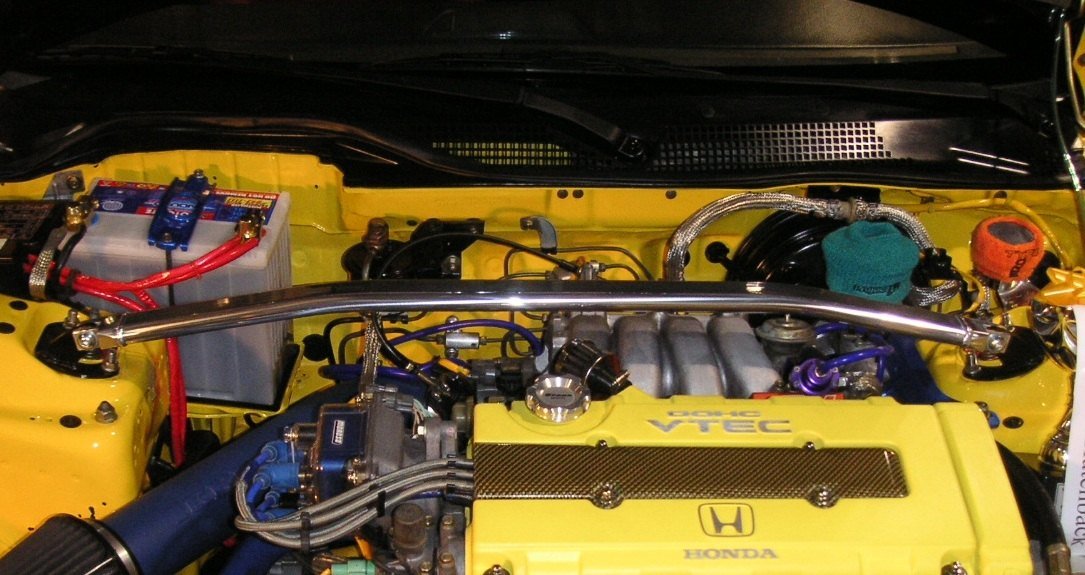
- Chassis code: confirm the platform code, not only the sales model. Related cars can have different tower spacing.
- Body style and model year: sedan, coupe, wagon and facelift variants can change cowl or hood packaging.
- Engine: intake plenums, charge pipes, engine covers and accessory layouts change clearance.
- Drive configuration: left- and right-hand drive may relocate brake, steering or wiring hardware.
- Factory options: adaptive hardware, OEM bracing, special-edition covers and auxiliary reservoirs can interfere.
- Hood and cowl clearance: allow for seals, insulation, engine movement and service access—not just a stationary visual check.
- Fastener specification: verify whether new hardware is supplied, whether factory nuts are reused and which official torque procedure applies.
These checks are why a catalog match must be specific. Compare, for example, the listed applications for the CSL-design BMW G8X brace, the front K-brace for BMW G87/G8X and the G8X carbon-fiber tower brace. Similar model names do not make installation details identical.
If your vehicle is outside those applications, browse the suspension, brakes and chassis collection and request a VIN-based fitment confirmation before ordering.
How to install a strut bar safely
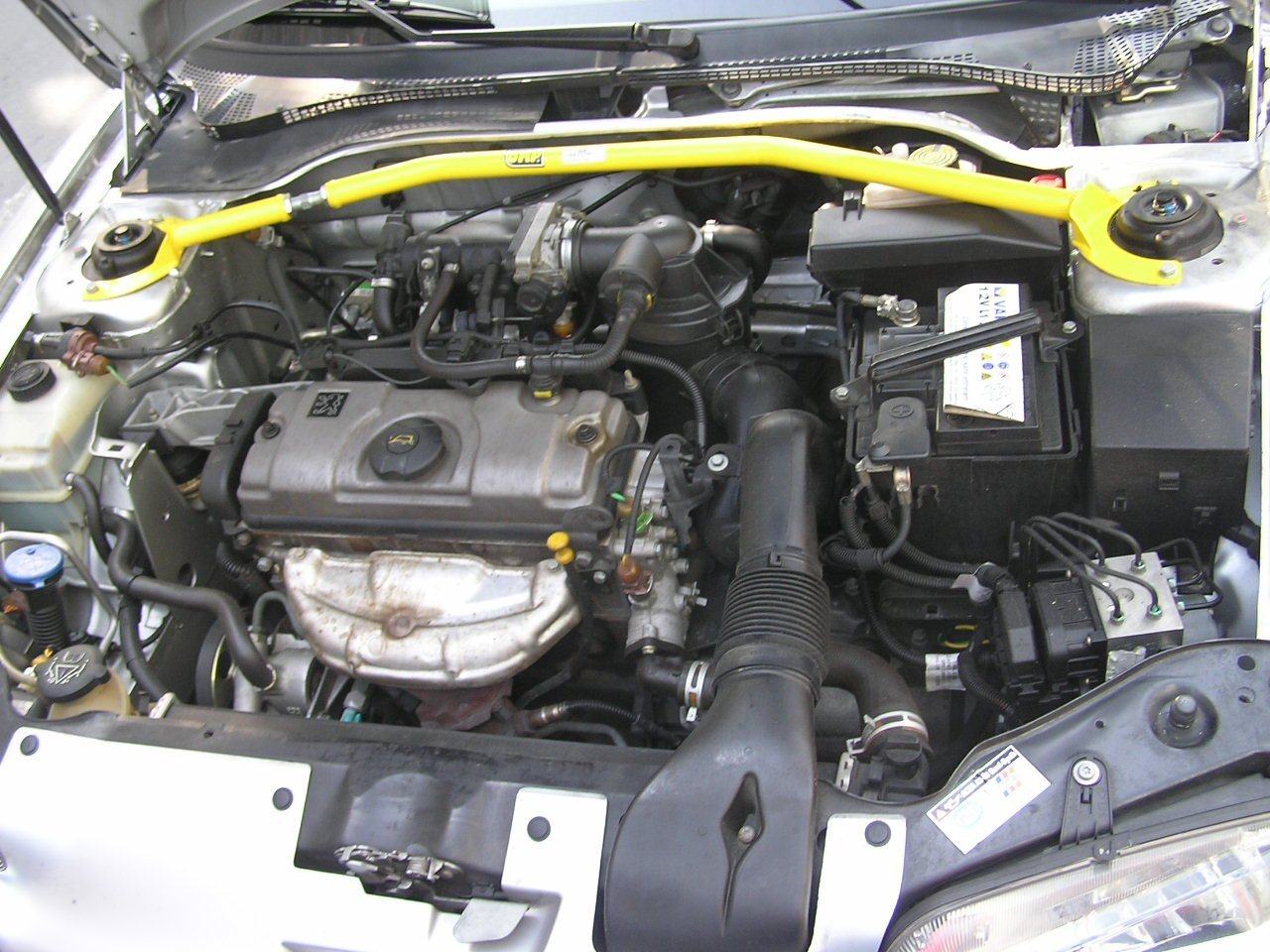
Installation often looks easy because the upper fasteners are visible. Those fasteners may also retain or locate suspension components, and torque values vary by vehicle. An official recall repair document hosted by NHTSA, for example, gives a specific brace and fastener procedure for one application. It is evidence that sequence and torque are application-specific—not a value to reuse on another car.
- Park on a level surface, switch off the engine and let hot components cool.
- Read the complete product instructions and the relevant factory service procedure.
- Record routing and clearances with photographs before disturbing clips, covers or hardware.
- Remove only the instructed fasteners. Do not loosen a center strut-shaft nut unless the service procedure explicitly requires it.
- Clean the mounting surface and set the brace in place without forcing alignment.
- Start all fasteners by hand, follow the specified sequence and use a calibrated torque wrench.
- Reinstall displaced harnesses or covers, close the hood slowly by hand and check clearance before latching.
- After the manufacturer’s stated interval, inspect for witness marks, loose hardware, noise and contact.
Manufacturer instructions provide useful examples of the differences between designs. Compare Whiteline’s vehicle-specific installation guide, PERRIN’s brace installation document and Dinan’s tower-brace instructions. They are references for process, not substitutes for the instructions supplied with your exact part.
Does the car need an alignment afterward?
A simple upper brace installed without shifting suspension geometry usually does not require an alignment solely because of the bar. Alignment is sensible if the procedure loosens geometry-setting fasteners, if the vehicle already pulls or wears tires unevenly, or if other suspension work is performed at the same time. Measure rather than guess.
Limitations and possible downsides
- Small return on a stiff chassis: the difference may be below what a driver can reliably detect on public roads.
- Noise transfer: a rigid new path can transmit more vibration or reveal existing rattles.
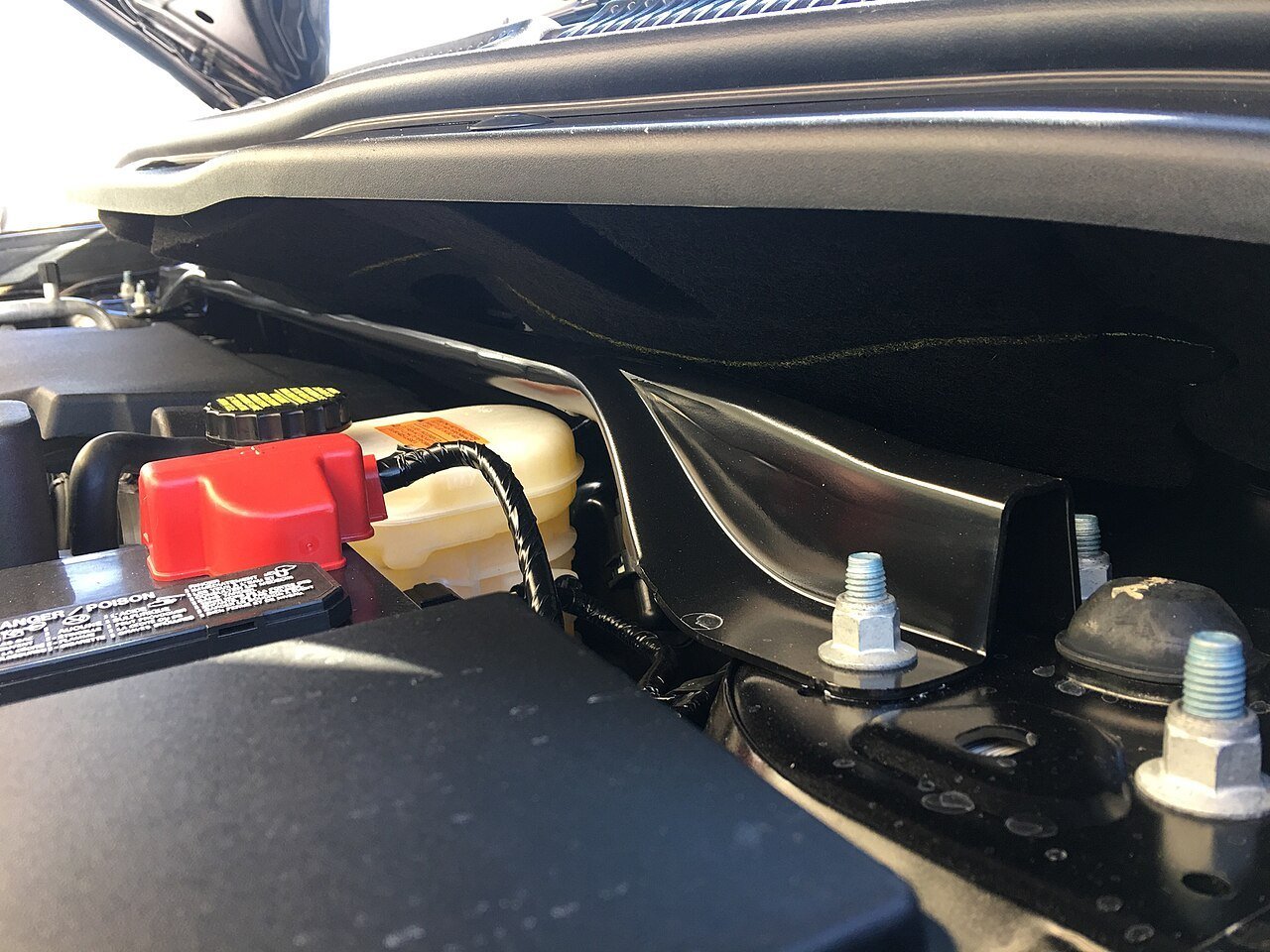
- Service obstruction: the bar may need removal for an air filter, battery, reservoir or engine-cover service.
- Clearance risk: contact with the hood, intake, wiring or moving engine can damage parts.
- Added mass: a heavy design placed high in the car should deliver enough benefit to justify itself.
- Collision/service considerations: added structure can alter access and load paths; notify repairers that the part is fitted.
The U.S. National Highway Traffic Safety Administration notes in an interpretation concerning aftermarket vehicle equipment that manufacturers, distributors, dealers and repair businesses have obligations not to knowingly make required safety equipment inoperative. Owners should preserve safety-system function and ask a qualified professional when a modification approaches sensors, restraint hardware or structural repair zones.
Buyer checklist
- Exact chassis, year, body, engine, drive side and factory-option compatibility documented.
- Mounting points and fastener reuse clearly shown in instructions.
- Hood, cowl, intake, reservoir, wiring and engine-movement clearance confirmed.
- Brace geometry provides a direct load path with credible joints and plates.
- Complete-part mass and material specification available.
- Torque values come from the correct product or vehicle procedure.
- Return policy covers an uninstalled test-fit if compatibility is uncertain.
- Worn mounts, bushings, ball joints, dampers and tires checked first.
Frequently asked questions
Will a strut bar reduce body roll?
Not in the same direct way as an anti-roll bar. It may help the structure hold suspension mounting relationships more consistently, but springs and anti-roll bars are the primary elastic elements controlling roll.
Does it increase horsepower?
No. It is a chassis component. Any claim of engine-power gain from the brace itself should be treated skeptically.
Is a three-point brace always better?
No. The third point must be strong, correctly located and joined through effective geometry. A poorly designed three-point part can be less useful than a direct, well-fitted two-point bar.
Can I use one with coilovers?
Often, but confirm top-mount hardware, adjuster access, stud length and the coilover maker’s procedure. Camber plates and remote reservoirs can change packaging.
Should the suspension be loaded during installation?
Follow the product instructions. Many upper braces are fitted on level ground with the vehicle at normal ride height, but the correct procedure depends on the mounting design. Do not invent preload by jacking one corner unless the manufacturer specifies it.
Bottom line: a brace is worth considering when it has a clear structural job, proven application and clean installation. Buy the geometry and fitment—not the color, weave or biggest promise.