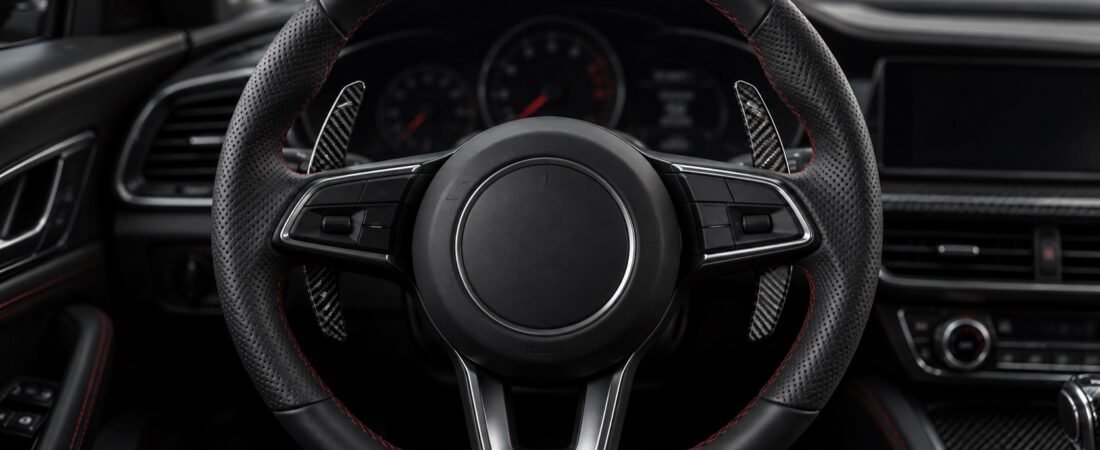
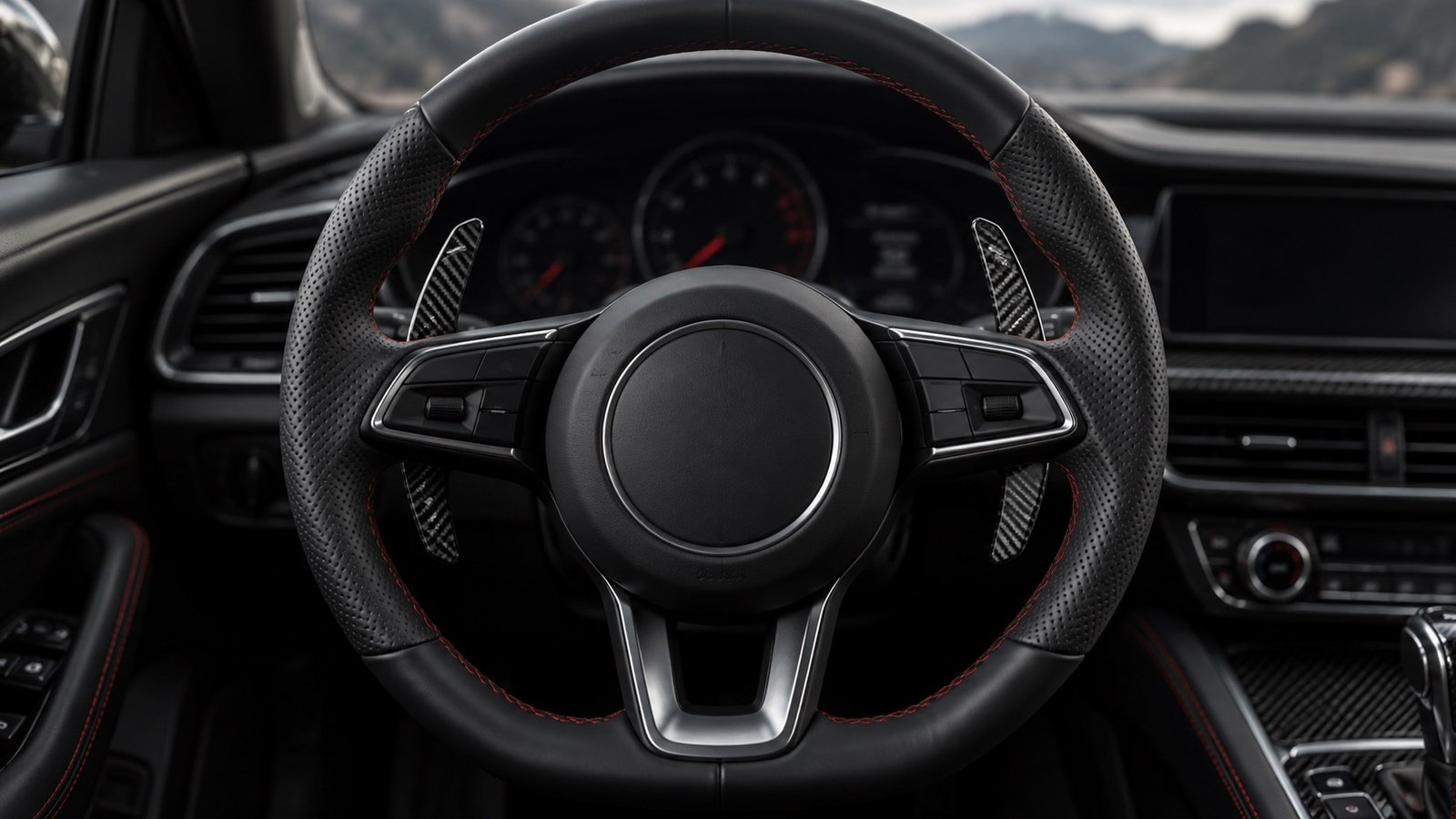
Carbon fiber paddle shifters look like a simple interior upgrade. In practice, two products that appear nearly identical online can differ in fit, reach, mounting method, edge quality, and even whether they replace the factory paddle or merely cover it. That difference determines how the part feels every time you change gear.
The best set should be easy to reach without becoming easy to hit by accident. It should clear the steering-wheel spokes and stalks, return freely after every pull, and match the rest of the cabin without looking like an add-on. This RevexaAuto guide explains the nine checks that matter before you order, including fitment evidence, extension versus replacement designs, carbon construction, installation risk, and finish quality.
Quick answer: what should you look for?
Buy only after the seller can confirm the exact vehicle year, model, chassis generation, steering-wheel style, and original paddle shape. Then decide whether you want a low-commitment extension or a full replacement. Check reach, spoke and stalk clearance, attachment method, edge finish, carbon construction, left-right symmetry, and unrestricted return movement.
A good listing should show the back of the part, the mounting points, both paddles, and at least one clear installed view. A front-only beauty photo is not enough evidence of fitment.
First, know what you are actually buying
The phrase “carbon fiber paddle shifters” is used for several different products. They do not install or behave the same way.
1. Adhesive paddle extensions
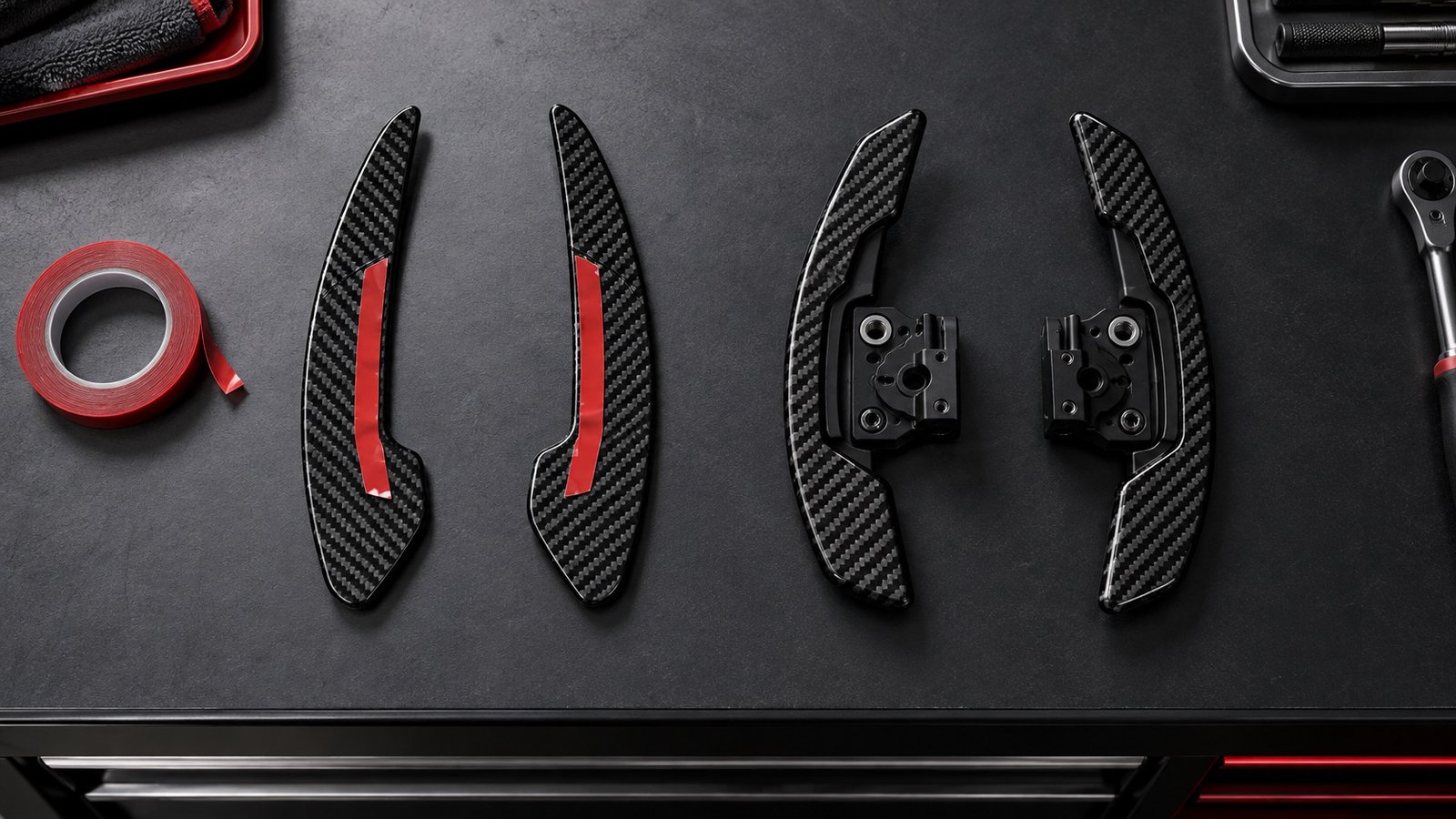
Extensions attach to the face or rear of the existing factory paddles, usually with pre-cut automotive adhesive. Their purpose is to increase the reachable area above and below the steering-wheel spoke.
They are usually the easiest type to reverse because the original mechanism stays in place. They can also add thickness and leverage to the factory paddle. If the molded curvature or tape coverage is poor, the extension may rock, lift at an edge, or feel less direct.
2. Clamp-on or screw-secured extensions
Some extensions use a small clamp, bracket, or set-screw arrangement. A well-designed mechanical mount can feel more secure than tape, but the hardware must not mark the original paddle, loosen into the steering column area, or interfere with the paddle’s movement.
3. Full replacement paddles
Replacement paddles take the place of the original paddle blades or assemblies. They can deliver a cleaner, more integrated appearance because there is no second layer sitting on top of the factory part. Installation is more involved, and compatibility must be exact. A wheel that looks similar from the front may use a different pivot, connector, switch module, or mounting boss behind it.
4. Magnetic conversion assemblies
Magnetic kits change more than the visible paddle. They may alter the actuation mechanism to create a sharper click. Treat these as a separate product class: they require precise vehicle-specific engineering and should never be assumed compatible just because an extension fits the same wheel.
Extensions vs replacements: which is better?
Neither type is automatically better. The right choice depends on how much installation work you accept and what you want to change.
| Decision factor | Adhesive or clamp-on extension | Full replacement paddle |
|---|---|---|
| Main benefit | Adds reach with minimal disassembly | Cleaner, more integrated appearance |
| Installation | Usually simpler | Usually requires wheel or trim disassembly |
| Reversibility | Often easier to return to stock | Original parts must be reinstalled |
| Added thickness | Yes, because it sits over the factory paddle | Usually less visual layering |
| Fitment tolerance | Still shape-specific | Pivot and mounting geometry must be exact |
| Best for | Daily drivers and first-time interior upgrades | Buyers prioritizing OEM-style integration |
Choose an extension if you mainly want more fingertip reach and an easy-to-reverse change. Choose a replacement if you want the most integrated result and have strong fitment evidence plus a safe installation plan.
The 9 checks to make before ordering
Check 1: confirm the exact chassis and model year
“Fits BMW,” “fits Mercedes,” or “universal” is too broad. Paddle geometry can change between generations, facelifts, trim levels, and steering-wheel packages. Ask for compatibility at this level:
- Vehicle make and model
- Model year or production date
- Chassis or platform code, when applicable
- Steering-wheel style or option package
- Left-hand-drive or right-hand-drive specification if the seller lists a difference
- A photo of your original paddle from the front and side
Semrush data for this topic shows model-specific searches such as Mercedes, BMW, Audi, Mustang, Corvette, and Q50 variations. That search behavior reflects the real buying problem: shoppers do not only want carbon fiber; they want proof that the part fits their exact wheel.
Check 2: compare the original paddle shape, not just the car
Two cars from the same year can have different steering wheels. Compare the seller’s underside and mounting photos with your own paddle. Look at the outline, curvature, location of the pull surface, holes, tabs, and pivot area.
For an overlay, the inner contour must follow the original paddle closely. A visible gap is not merely cosmetic; it reduces adhesive contact and can allow the extension to flex. For a replacement, the hidden mounting geometry is more important than the visible face.
Check 3: choose a useful extension length
Longer paddles are not always more ergonomic. The goal is to make shifts available from your normal hand positions, including during moderate steering input, without putting a large lever where your fingers can hit it accidentally.
Before buying, note where your fingertips naturally sit at the 9-and-3 position. Imagine the proposed paddle extending above and below that zone. Very long paddles may look dramatic in photos but can crowd steering-wheel buttons, stalks, or your hands during parking maneuvers.
Check 4: verify clearance through the wheel’s full movement
Clearance must be checked in more than the straight-ahead position. The paddle should not contact:
- The rear of the steering-wheel spokes
- Turn-signal or wiper stalks
- Fingers wrapped around the rim
- Decorative trim or switch housings
- The column shroud at any steering angle
After installation, turn the wheel slowly from lock to lock while stationary and verify that both paddles pull and return without rubbing. If anything binds, stop using the upgrade until the cause is corrected.
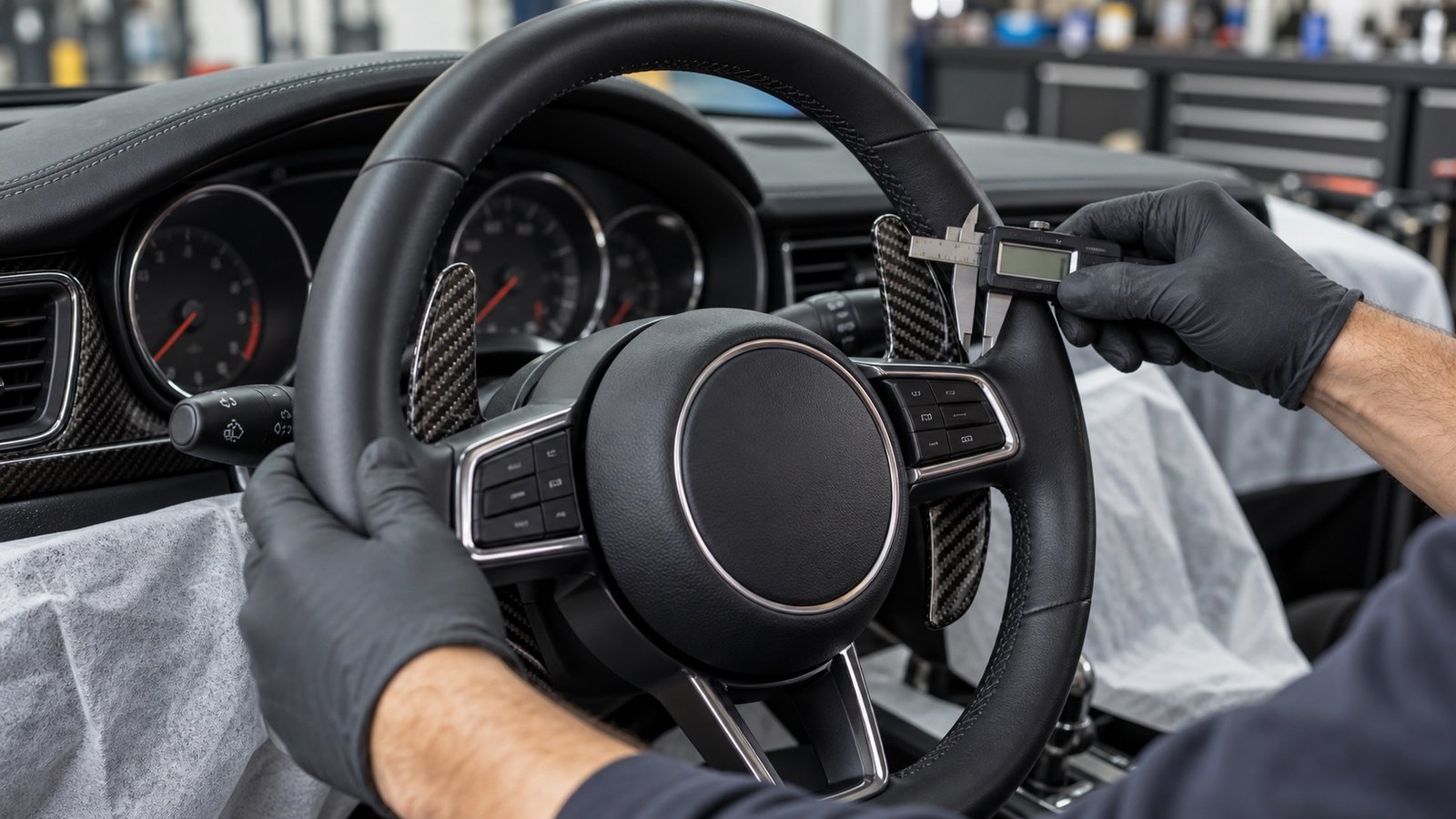
Check 5: inspect the attachment method
For adhesive extensions, the tape should be die-cut to cover stable contact areas without protruding beyond the edge. A tiny generic strip is a warning sign. The mating surfaces should be clean, dry, and at a suitable temperature before application. Follow the adhesive manufacturer’s cure instructions instead of testing the bond immediately.
For clamp-on extensions, confirm that the supplied hardware is captured securely and cannot loosen toward the steering column. For replacements, request a photo or diagram of the pivot and attachment points. Do not drill or modify an original paddle unless the product was explicitly engineered and documented for that procedure.
Check 6: distinguish real carbon from carbon-look decoration
“Carbon style” can describe printed vinyl, hydro-dipped plastic, or a molded pattern. Those finishes may be acceptable when priced and described honestly, but they are not the same as a real carbon-fiber laminate.
Useful listing evidence includes close macro photos, visible weave depth beneath the clear coat, consistent edge finishing, and a clear material description. On a real woven part, the pattern follows the surface and changes subtly with the viewing angle. A flat, perfectly repeated checkerboard can indicate a printed surface.
The structural benefit of carbon matters less on a tiny extension than fit and ergonomics, so do not buy based on the word “lightweight” alone. Buy for verified construction, clean execution, and the way the part functions on your wheel.
Check 7: examine the edges and clear coat
Your fingers contact these parts frequently. Every exposed edge should be smooth, rounded, and sealed. Reject parts with sharp corners, resin ridges, pinholes, cloudy clear coat, lifted fibers, or unfinished undersides.
Gloss highlights the weave and often matches glossy interior trim. Satin reduces reflections and can look more factory-like. Forged carbon uses randomly oriented chips rather than an ordered twill pattern; it is a visual choice, not proof that the part fits or performs better.
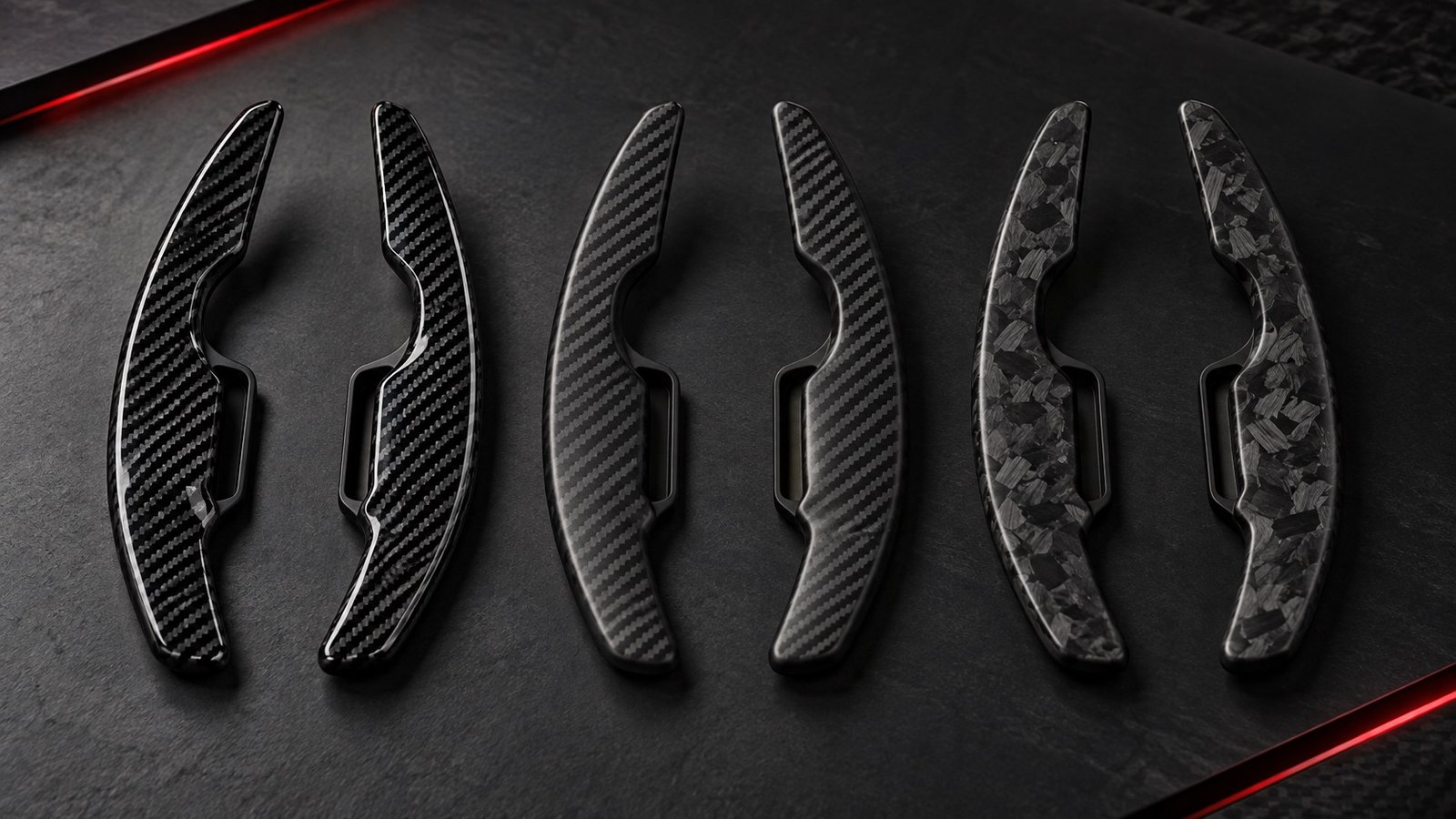
Check 8: confirm left-right symmetry and markings
A matched set should mirror correctly around the wheel. Compare the top and bottom lengths, mounting surfaces, and edge thickness on both sides. If plus and minus symbols are present, they should be oriented correctly for your vehicle and should not be printed where normal contact quickly wears them away.
Some cars display shift direction on the factory paddle or instrument cluster; others place symbols on the paddle itself. Do not assume a decorative aftermarket marking changes the vehicle’s programmed function.
Check 9: protect return travel and tactile feedback
The paddle must return immediately after every pull. An extension should not flex independently before the factory switch engages, and no adhesive should squeeze into a moving gap. A replacement should retain smooth pivot motion and consistent left-right engagement.
Test both sides repeatedly while stationary before driving. If one side feels slower, sticks, touches nearby trim, or needs noticeably different force, remove or correct the part. Appearance never outranks reliable control operation.
A practical fitment message to send a seller
Copy this checklist into your inquiry:
I have a [year] [make] [model], chassis [code if known], with the [steering-wheel style/package]. My original paddles are shown in the attached front, side, and rear photos. Is this item an extension or a full replacement? Please confirm the exact mounting method, left and right part shape, required disassembly, and whether the paddle clears the spokes and stalks through full steering travel.
For a RevexaAuto fitment request, include the vehicle identification details requested by the product team plus clear wheel and paddle photos. Good inputs reduce guesswork and help separate a genuine application match from a visually similar part.
Installation: when DIY is reasonable and when to stop
An adhesive extension may be a reasonable DIY job when the product is specifically molded for the original paddle and the instructions require no steering-wheel disassembly. Dry-fit both pieces first. Confirm full surface contact, equal alignment, and unrestricted movement before exposing the adhesive.
A full replacement or magnetic assembly can involve the steering wheel, electrical connectors, and the airbag area. Incorrect handling can damage trim, trigger faults, or create a safety risk. If the procedure requires removing the airbag module or you are unsure about battery-disconnection and manufacturer service steps, use a qualified automotive technician. Never probe airbag wiring or improvise around the restraint system.
After any installation:
- Confirm the steering wheel and all trim are fully secured.
- Check that both paddles move and return freely while stationary.
- Verify no warning lights or fault messages are present.
- Turn the wheel through its full range and listen for contact.
- Begin with a low-speed functional check in a safe area.
How to care for carbon fiber paddle shifters
Wipe the paddles with a soft microfiber cloth and a mild interior cleaner that is compatible with the clear coat. Avoid abrasive polish on satin finishes because it can create glossy patches. Do not soak adhesive edges, and keep harsh solvents away from resin, paint, tape, and nearby leather.
Inspect adhesive extensions periodically, especially after hot weather. Stop using a part if an edge lifts, the piece shifts under finger pressure, or the paddle no longer returns consistently.
Red flags in an online listing
- The title says “universal,” but the product follows a highly specific paddle shape.
- Only front-facing photos are provided; the back and mounting surfaces are hidden.
- One image is reused across unrelated vehicle generations.
- “Real carbon” appears in the title, while the description only says ABS or carbon pattern.
- No left and right parts are shown together.
- The listing promises easier installation but never identifies extension versus replacement.
- Compatibility depends only on make and model, with no year, chassis, or wheel-style detail.
- The seller cannot explain what happens to the original paddle or how the new part is retained.
RevexaAuto buyer’s checklist
Before placing an order, make sure you can answer all nine questions:
- Does the listing match the exact year, chassis, and steering-wheel style?
- Does the product contour match your original paddles?
- Is it an extension, a replacement, or a magnetic assembly?
- Is the added reach useful without becoming intrusive?
- Will it clear spokes, stalks, hands, and trim at every steering angle?
- Is the mounting method visible and appropriate?
- Is the carbon construction described honestly?
- Are the edges, finish, and left-right symmetry clean?
- Can both paddles move and return without interference?
If a listing cannot answer those questions, pause before buying. RevexaAuto recommends choosing verified fitment over a low price or a dramatic product photo. Explore more real carbon fiber car accessories or browse interior trim and controls to build a coordinated cabin rather than mixing unrelated finishes.
Frequently asked questions
Do carbon fiber paddle shifters make a car shift faster?
Ordinary extensions and replacement blades do not change transmission programming or shift speed. They mainly change reach, tactile feel, and appearance. A magnetic mechanism can change the click sensation, but it still does not rewrite the transmission’s control strategy.
Can I add paddle shifting to a car that does not have factory paddles?
Not with a simple extension or replacement blade. These products rely on an existing paddle-shift system. Retrofitting functionality can require compatible electronics, coding, steering-wheel hardware, and vehicle-specific engineering.
Are adhesive paddle extensions safe?
They can be suitable when they are molded for the exact factory paddle, use appropriate automotive adhesive, and do not interfere with movement. The bond and return action should be inspected regularly. Remove the extension if it shifts, lifts, or binds.
Is forged carbon better than woven carbon for paddle shifters?
Not automatically. On a small interior control, fit, edge quality, mounting, and finish usually matter more than the visual pattern. Woven and forged carbon provide different appearances; neither compensates for poor geometry.
Can paddle extensions damage the factory paddles?
Adhesive can leave residue, while clamps or set screws can mark the surface if poorly designed or over-tightened. Use a model-specific product, follow its removal instructions, and avoid metal tools against visible factory trim.
Should I install replacement paddles myself?
Only if the manufacturer provides a vehicle-specific procedure and you are qualified to work around the steering wheel and restraint system. If airbag removal or unfamiliar electrical work is involved, professional installation is the safer choice.
Final verdict
The right carbon fiber paddle shifters should feel like they belong on the wheel: easy to reach, smooth to operate, secure at the mount, and consistent with the cabin. The fastest way to avoid a disappointing purchase is to identify the upgrade type first, verify the exact original paddle geometry, and treat clearance and return travel as non-negotiable.
Need help checking an application? Send RevexaAuto your vehicle year, model, chassis code, steering-wheel style, and clear paddle photos through the fitment and quote request form.