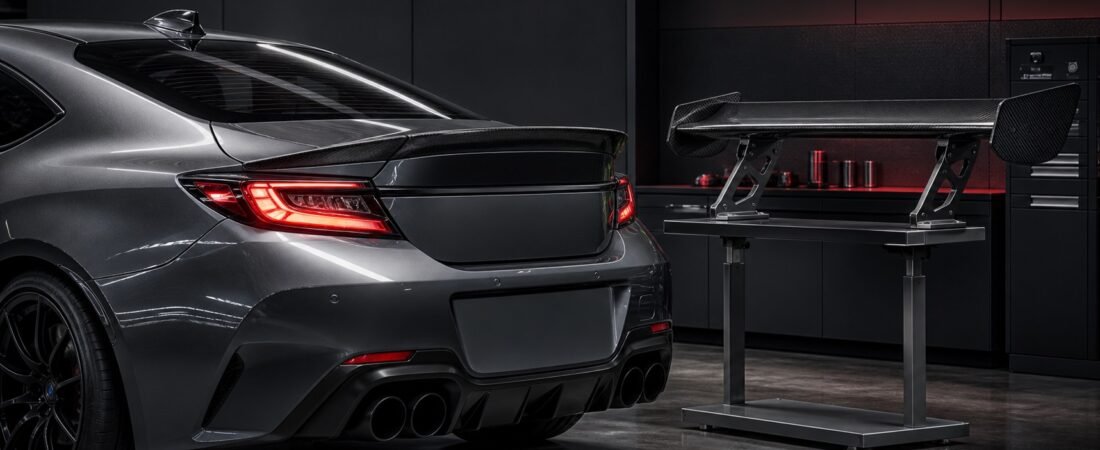
A carbon fiber spoiler and a carbon fiber rear wing can both transform the rear of a car, but they are not interchangeable terms. A spoiler usually follows the trunk or hatch and alters airflow close to the body. A wing is elevated into the airflow on uprights and may be designed to create downforce. The right choice depends on the vehicle, mounting surface, intended use and the engineering behind the shape.
Spoiler or wing: the quick answer
Choose a low-profile, vehicle-specific rear spoiler when you want an integrated appearance and relatively simple fitment. Consider a properly engineered rear wing when the project has a defined aerodynamic goal and the mounting structure can support it. Carbon fiber reduces component mass and provides a premium finish, but the material alone does not guarantee aerodynamic performance.
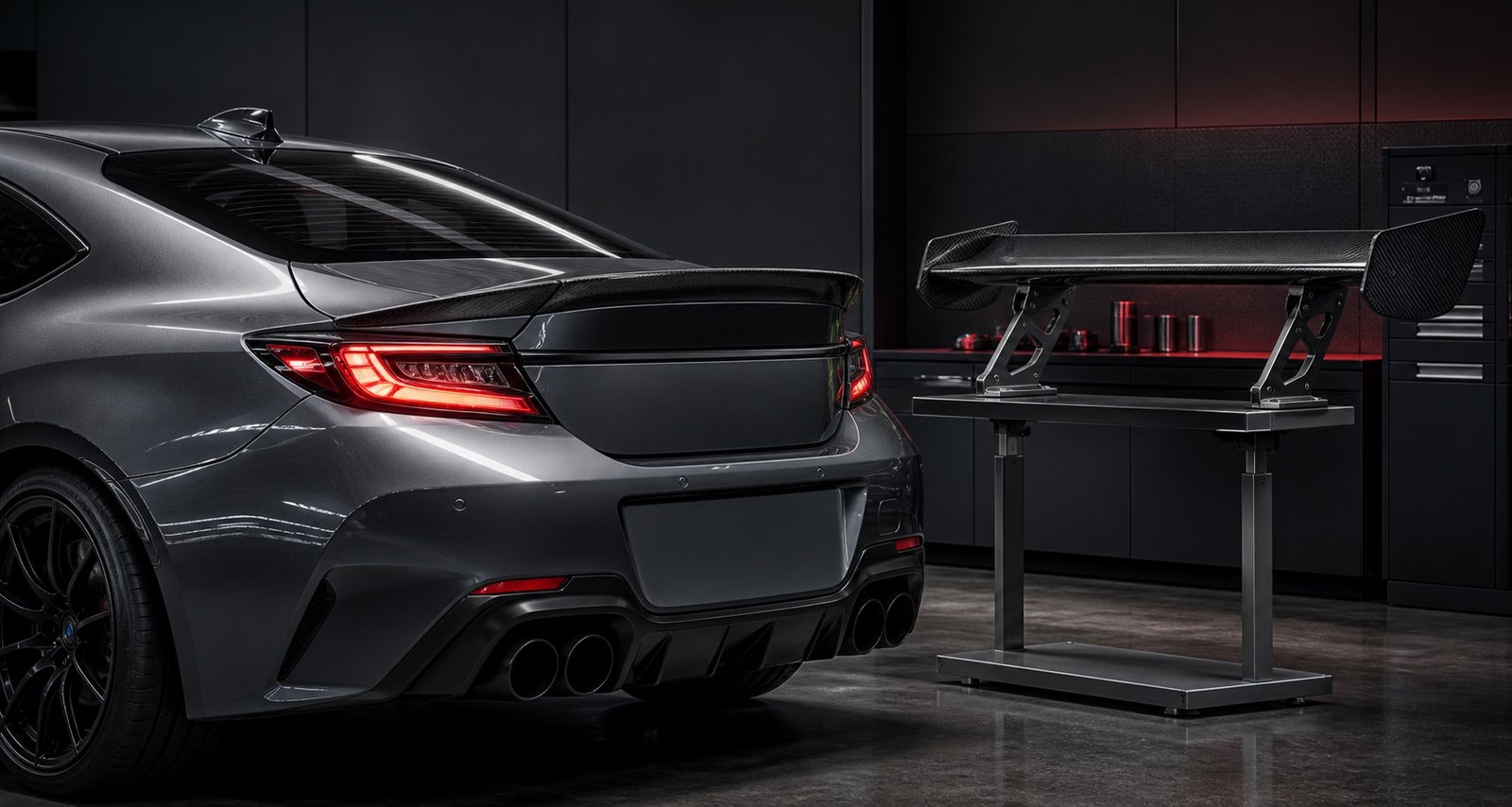
Carbon fiber spoiler vs rear wing
| Feature | Rear spoiler | Rear wing |
|---|---|---|
| Position | Close to the trunk, hatch or roof edge | Raised above the body on uprights |
| Typical goal | Integrated styling and local airflow management | More defined aerodynamic loading when engineered for the vehicle |
| Mounting | Tape, existing holes, bolts or a combination | Usually bolted through reinforced mounting points |
| Fitment sensitivity | Must match the exact deck contour | Requires correct base geometry, width, height and structural support |
| Adjustment | Usually fixed | Some designs offer angle adjustment |
| Daily-use impact | Often subtle with fewer visibility concerns | May affect rear visibility, trunk access and cleaning |
What a spoiler actually does
The word spoiler describes a surface that changes or “spoils” airflow as it leaves the body. Depending on its shape and location, it may reduce rear lift, manage separation or primarily provide a visual change. The effect depends on the complete vehicle, not the spoiler in isolation.
A carbon fiber rear spoiler does not automatically produce more downforce than an identical fiberglass or plastic shape. Aerodynamic behavior comes mainly from geometry, position and airflow. Carbon fiber can make the component lighter and stiffer and can provide the exposed-weave finish buyers want.
What makes a rear wing different?
A rear wing works as an aerodynamic profile placed in the airflow. Its section, angle, height, endplates, mounting stiffness and relationship with the rest of the car determine how it behaves. A large visual profile is not proof that it has been tested.
For track-oriented builds, ask for application-specific aerodynamic information and confirm that the chassis or body mounting locations can carry the expected loads. A wing mounted only to a flexible outer trunk skin may not provide a stable platform. Street customers should also consider local regulations, pedestrian safety, visibility and access to the trunk or hatch.
Common spoiler styles
Lip spoiler
A lip spoiler sits close to the rear edge and usually follows the factory deck line. It is a popular choice for a restrained OEM-style appearance. Precision around the corners and centerline matters because a long, thin carbon part makes uneven gaps visible.
Ducktail spoiler
A ducktail rises more sharply from the deck and creates a stronger visual profile without separate uprights. Some designs replace the trunk lid; others bond or bolt to the original panel. Confirm whether the listing is for the complete trunk or only the spoiler.
Roof spoiler
A roof spoiler attaches above the rear glass on a hatch, wagon or SUV. It must match roof trim, hatch movement and any factory antenna or washer system. Check rear-wiper and tailgate clearance throughout the full opening range.
Active-spoiler extension or replacement
Vehicles with factory active aero require special care. Added weight, altered travel, wiring and calibration can affect the system. Use a product specifically designed for the active mechanism and follow the vehicle-specific instructions.
Vehicle-specific vs universal carbon spoilers
A vehicle-specific carbon fiber car spoiler is molded to the exact trunk or hatch contour. It usually provides the cleanest alignment and clearest installation path. A universal spoiler may offer flexibility, but “universal” does not mean it will sit correctly on every surface. The installer must evaluate base contact, curvature, drilling access and reinforcement.
For a street vehicle, the apparent saving from a universal part can disappear if custom bases, refinishing or repeated alignment work are required. Start with the RevexaAuto spoilers and wings collection and filter by vehicle application before considering a multi-fit design.
Fitment questions to answer before ordering
- What are the exact make, model, year, generation and body style?
- Is the trunk or hatch original, aftermarket or already fitted with a factory spoiler?
- Does the kit reuse factory holes, require drilling or install with automotive tape?
- Are templates, hardware, seals and reinforcement plates included?
- Will the part interfere with a camera, antenna, active-aero mechanism, hatch glass or trunk opening?
- For a wing, what are the overall width, upright spacing, base dimensions and adjustment range?
- Are installed photographs available for the same vehicle version?
Mounting methods and installation
Automotive adhesive tape
Some lightweight lip spoilers are designed for high-quality automotive tape. Surface preparation, temperature, tape specification and full contact area are essential. Tape should not be used simply because drilling is inconvenient if the manufacturer specifies mechanical fasteners.
Bolted installation
Bolts provide positive retention but require careful measurement, corrosion protection and sealing. Use the supplied template when available. Check both sides of the panel for wiring, bracing and access before drilling.
Wing uprights and reinforcement
A rear wing transfers load through its uprights. Mounts may require backing plates or a connection to stronger structure. Installation should be performed by a workshop familiar with composite aero parts and the specific vehicle.
How to evaluate carbon quality
Inspect weave alignment, edge finishing, underside construction and clearcoat just as you would with another exposed carbon part. Thin spoiler edges should be sealed, mounting studs should be bonded cleanly and brackets should sit square. Ask whether the product uses full carbon construction, a carbon outer skin or a composite base with cosmetic carbon.
If matching existing parts, specify weave pattern, direction, gloss or matte finish and color. Small differences become obvious across a trunk lid, diffuser and spoiler viewed together.
Frequently asked questions
Is a carbon fiber spoiler better than a plastic spoiler?
It can be lighter and stiffer and offers a real carbon finish, but “better” depends on design, fitment, finish and price. A well-fitted factory plastic spoiler may be more practical than a poorly made carbon part.
Does a carbon fiber spoiler improve performance?
The material does not create performance by itself. Any aerodynamic benefit comes from the shape, position and interaction with the vehicle. Ask for application-specific evidence when performance is the main goal.
Can I install a spoiler without drilling?
Some lip spoilers are engineered for adhesive installation; others require bolts. Follow the instructions for the exact product. Do not replace specified mechanical fasteners with tape without approval.
Will a universal spoiler fit my car?
It may be adaptable, but base curvature, available mounting area and reinforcement must be checked. Vehicle-specific products usually reduce installation uncertainty.
Should the wing be wider than the car?
Wing dimensions should be chosen by application and applicable regulations, not a universal visual rule. Confirm overall width, mirror width, intended use and local requirements.
Make the choice around the vehicle and intended use
For most styling-led road builds, a vehicle-specific carbon spoiler provides the cleanest combination of appearance and straightforward installation. A rear wing makes more sense when the project has a defined aerodynamic target and suitable mounting structure. Read the broader body kit, front lip and spoiler fitment guide, or send RevexaAuto your vehicle details for a product and fitment review.